

The Definitive Guide to AHA BLS (2025 Updates) https://medium.com/p/the-definitive-guide-to-aha-bls-2025-updates-1662a44ecf31?source=social.tw
🆕 2025 GUIDELINES RELEASED
The Definitive Guide to AHA BLS (2025 Updates)
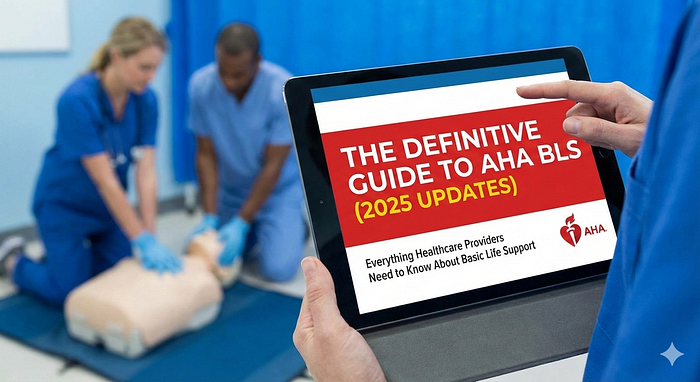
Everything Healthcare Providers Need to Know About Basic Life Support
Get BLS Certified with the Latest 2025 Guidelines
Pinpoint Pulse CPR and First Aid School
110 Davis Road, Suite 18, Martinez, GA 30907
📞 Call Now: 706–901–7277
American Heart Association Training Center | Expert Instructors | Same-Day Certification
The American Heart Association has released its groundbreaking 2025 Guidelines for CPR and Emergency Cardiovascular Care, representing the most significant updates to Basic Life Support (BLS) protocols in years. As a healthcare provider, staying current with these evidence-based changes isn’t just about maintaining certification — it’s about providing the highest standard of care and maximizing survival rates for cardiac arrest patients.
This comprehensive guide breaks down everything you need to know about the 2025 AHA BLS guidelines, from fundamental concepts to critical updates that will impact your daily practice. Whether you’re seeking BLS certification near Martinez, Georgia, preparing for recertification, or simply wanting to stay informed on the latest resuscitation science, this article provides the authoritative information you need.
What is AHA BLS? Understanding Basic Life Support for Healthcare Providers
Basic Life Support (BLS) represents the foundation of emergency cardiovascular care and is an essential competency for all healthcare professionals. According to the American Heart Association, BLS encompasses the knowledge and skills necessary to recognize several life-threatening emergencies, provide high-quality chest compressions, deliver appropriate ventilations, and use an automated external defibrillator (AED).
BLS vs. Heartsaver: Understanding the Critical Difference
BLS for Healthcare Providers
- Target Audience: Doctors, nurses, paramedics, EMTs, respiratory therapists, dental professionals, medical students
- Scope: Advanced techniques including two-rescuer CPR, bag-valve-mask ventilation, opioid overdose response
- Assessment Skills: Pulse checks, breathing assessment, systematic approach
- Team Dynamics: Emphasizes coordinated team resuscitation efforts
- Certification Length: 2 years
- Required For: Healthcare licensure, hospital employment, clinical rotations
Heartsaver CPR AED (Lay Rescuer)
- Target Audience: Teachers, coaches, fitness instructors, daycare workers, general public
- Scope: Basic single-rescuer CPR, AED use, choking relief
- Assessment Skills: Simplified check for responsiveness and breathing
- Team Dynamics: Focuses on individual rescuer actions
- Certification Length: 2 years
- Required For: Workplace requirements, volunteer positions, personal preparedness
Why Healthcare Providers Need BLS, Not Just Heartsaver
Healthcare providers work in environments where cardiac arrest is more likely and where advanced interventions are available. BLS training prepares you to function as part of a resuscitation team, use professional equipment like bag-valve masks, assess patients systematically, and make critical clinical decisions. According to the National Institutes of Health, hospitals and healthcare facilities universally require BLS certification because it represents the standard of care for medical professionals.
🆕 Key 2025 AHA Guideline Updates: What’s Changed and Why It Matters
The 2025 guidelines represent a significant evolution in resuscitation science, incorporating data from thousands of cardiac arrest cases worldwide and recommendations from the International Liaison Committee on Resuscitation (ILCOR). These updates reflect the most current evidence on what works to save lives.
Update #1: The Single Universal Chain of Survival
Major Change: One Chain of Survival for All Ages
Previous guidelines used different “chains of survival” for adults, children, and in-hospital vs. out-of-hospital cardiac arrest. The 2025 guidelines consolidate these into a single, universal chain of survival applicable to all ages and settings, making it easier for healthcare providers to remember and apply.
Link 1
Recognition & Activation of Emergency Response
Link 2
Immediate High-Quality CPR
Link 3
Rapid Defibrillation
Link 4
Advanced Life Support & Post-Arrest Care
Link 5
Why This Matters: Research published in the Circulation journal shows that survival from cardiac arrest depends on the rapid execution of each link. By standardizing the chain across all populations, the AHA aims to improve consistency and reduce confusion during critical moments.
Update #2: Revised Choking (Foreign Body Airway Obstruction) Protocol
New Sequence: 5 Back Blows + 5 Abdominal Thrusts
The 2025 guidelines introduce a significant change to choking management, now recommending an alternating sequence of 5 back blows followed by 5 abdominal thrusts (Heimlich maneuver) for conscious adults and children. This replaces the previous approach of abdominal thrusts alone.
The Evidence: International studies reviewed by ILCOR, including research from the Resuscitation Journal, demonstrate that combining back blows with abdominal thrusts increases the likelihood of dislodging obstructions. Back blows create a sudden increase in intrathoracic pressure that can expel foreign bodies, while abdominal thrusts provide an additional mechanism of action.
1Stand behind the victim and deliver 5 back blows
- Position yourself to the side and slightly behind the victim
- Support their chest with one hand
- Bend the person forward at the waist
- Deliver 5 sharp blows between the shoulder blades with the heel of your hand
2Perform 5 abdominal thrusts
- Stand behind the victim and wrap your arms around their waist
- Make a fist with one hand and place it just above the navel
- Grasp your fist with the other hand
- Perform 5 quick, upward thrusts
3Continue alternating until object is expelled or victim becomes unconscious
- Repeat the cycle of 5 back blows and 5 abdominal thrusts
- If the victim becomes unconscious, carefully lower them to the ground and begin CPR
- Each time you open the airway to give breaths, look for the object and remove it if visible
Special Consideration: Pregnant and Obese Patients
For patients in late pregnancy or those with significant obesity, the 2025 guidelines recommend using chest thrusts instead of abdominal thrusts. Position your hands in the center of the chest (same location as CPR compressions) and perform inward thrusts. This modification prevents potential harm to the fetus or internal organs while maintaining effectiveness.
Update #3: Enhanced Emphasis on Rapid Naloxone (Narcan) Administration
Opioid Overdose Response Now Integrated into BLS
Recognizing the devastating opioid crisis, the 2025 AHA guidelines formally integrate opioid-associated emergency response into standard BLS protocols. Healthcare providers are now trained to recognize opioid overdose and administer naloxone (Narcan) as part of the initial assessment and treatment.
According to the Centers for Disease Control and Prevention, opioid overdoses claim over 80,000 American lives annually, with many deaths occurring in healthcare settings. The integration of naloxone administration into BLS training reflects the reality that opioid-related cardiac arrests are increasingly common.
The 2025 Opioid Overdose Response Algorithm:
- Recognize potential opioid overdose: Unresponsive patient, slow or absent breathing, pinpoint pupils
- Activate emergency response and send for naloxone and AED
- Check breathing and pulse (no more than 10 seconds)
- Administer naloxone immediately if available (intranasal or intramuscular)
- Begin CPR if not breathing normally — Do NOT delay CPR to give naloxone
- Continue high-quality CPR and be prepared to give additional naloxone doses every 2–3 minutes
- Place in recovery position if breathing resumes and monitor for re-sedation
Key Point: CPR Takes Priority
The 2025 guidelines emphasize that while naloxone is important, it should NEVER delay the initiation of CPR. According to research in the New England Journal of Medicine, brain damage begins within 4–6 minutes of cardiac arrest. Naloxone typically takes 2–5 minutes to work, so high-quality CPR must begin immediately to maintain cerebral perfusion.
Where to Get Naloxone Training: At Pinpoint Pulse CPR and First Aid School in Martinez, GA, our BLS courses now include comprehensive training on opioid overdose recognition and naloxone administration, ensuring you’re prepared for this increasingly common emergency. Call us at 706–901–7277 to enroll today.
Update #4: Refined Ventilation Fundamentals for Healthcare Providers
New Recommendations for Rescue Breathing
The 2025 guidelines provide updated guidance on ventilation techniques, emphasizing the importance of adequate oxygenation without hyperventilation. Research shows that excessive ventilation during CPR is harmful and reduces survival rates.
Key Ventilation Updates:
- Tidal Volume: Deliver breaths over 1 second, just enough to see visible chest rise (approximately 500–600 mL for adults)
- Avoid Excessive Ventilation: Do NOT deliver forceful or prolonged breaths — this increases intrathoracic pressure and reduces blood return to the heart
- Bag-Valve-Mask Technique: Two-handed (E-C clamp) technique is now the standard for healthcare providers to ensure proper seal and airway positioning
- Oxygen Supplementation: When available, supplemental oxygen should be used during resuscitation to maximize oxygen delivery
- Advanced Airway: Once an advanced airway (ET tube, supraglottic airway) is placed, deliver 1 breath every 6 seconds (10 breaths/minute) without pausing compressions
Why Hyperventilation is Dangerous
Studies published in the Journal of the American Medical Association show that hyperventilation during CPR dramatically decreases venous return to the heart, reduces cardiac output, and worsens outcomes. The 2025 guidelines specifically address this common error by emphasizing controlled, measured breaths.
The High-Quality CPR Cheat Sheet: Master the Numbers
High-quality CPR is the cornerstone of successful resuscitation. The 2025 AHA guidelines continue to emphasize that excellent CPR technique directly correlates with survival. Here’s your essential reference guide:
Here’s a well-crafted comment you can use:
Comment:
This is exactly the kind of comprehensive, up-to-date resource healthcare providers need right now! I’ve been searching everywhere for clear information on the 2025 AHA guidelines, and this article breaks everything down perfectly.
The comparison between BLS and Heartsaver was particularly helpful – so many people get confused about which certification they actually need. I also appreciate how you integrated the opioid overdose response updates. With fentanyl-related emergencies becoming so common, it’s critical that every healthcare provider knows how to respond with both Narcan and high-quality CPR.
The step-by-step choking protocol with the new 5 back blows + 5 abdominal thrusts sequence is going to be my go-to reference. I’m sharing this with my entire department.
For anyone in the Augusta/Martinez area looking for certification, I’ve trained with Pinpoint Pulse before and their instructors really know their stuff. They stay current with every guideline update and make the training practical and engaging.
Thanks for putting together such a thorough guide. This is getting bookmarked for sure! 🚑❤️