
The Complete Guide to Head-to-Toe Patient Assessment: Why Every CPR-Certified Professional Needs This Skill
Last Updated: December 2025 | Pulse CPR School – Martinez, GA
When seconds matter in a cardiac emergency, knowing how to perform a thorough head-to-toe assessment can be the difference between life and death. At Pulse CPR School in Martinez, Georgia, we don’t just teach CPR certification—we empower healthcare professionals, first responders, and concerned citizens with comprehensive life-saving skills that extend far beyond chest compressions.
Understanding the Critical Connection Between Patient Assessment and Cardiovascular Health
Why Head-to-Toe Assessments Matter in Cardiac Emergencies
Before administering CPR or calling for advanced medical support, understanding a patient’s complete physical condition provides crucial context that can guide your emergency response. A systematic head-to-toe assessment helps identify:
- Early warning signs of cardiac distress
- Underlying conditions that may complicate resuscitation efforts
- Contraindications for certain emergency procedures
- Critical information for EMS personnel when they arrive
According to the American Heart Association, early recognition of cardiac arrest symptoms increases survival rates by up to 40%. This is why our CPR training programs at Pulse CPR School integrate comprehensive patient assessment techniques with hands-on cardiac life support skills.
The HEAD-TO-TOE Assessment Framework: A Complete Breakdown
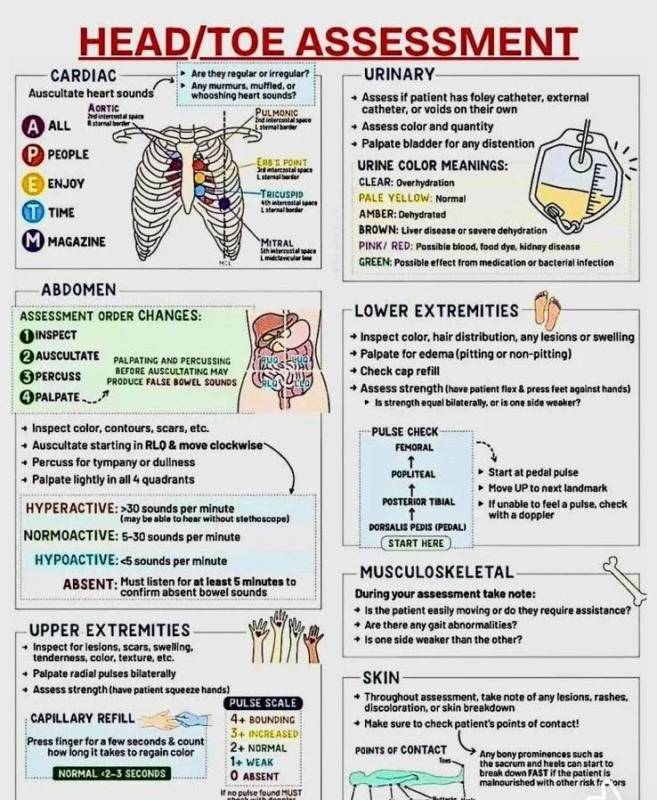
CARDIAC Assessment: The Foundation of Heart Health Evaluation
When assessing cardiac function, healthcare providers use the mnemonic “A-P-E-T-M” to ensure nothing is overlooked:
A – Auscultate Heart Sounds
Listening to heart sounds helps identify:
- Aortic valve issues in the second intercostal space at the right sternal border
- Pulmonic valve abnormalities in the second intercostal space at the left sternal border
- Tricuspid valve problems in the fourth/fifth intercostal space at the left sternal border
- Mitral valve complications at the fifth intercostal space in the midclavicular line
Connection to CPR Training: Understanding normal versus abnormal heart sounds prepares you to recognize when a patient is deteriorating and may need immediate CPR intervention. At Pulse CPR School, we teach students to identify signs of cardiac compromise before full arrest occurs.
P – People (Are They Regular or Irregular?)
Assessing heart rhythm regularity helps detect:
- Arrhythmias that may precede cardiac arrest
- Atrial fibrillation, which increases stroke risk
- Ventricular tachycardia, a life-threatening emergency
E – Enjoy (Murmurs)
While seemingly lighthearted, this step reminds assessors to listen for heart murmurs that may indicate:
- Valve stenosis or regurgitation
- Structural heart abnormalities
- Increased cardiac arrest risk
T – Time (Rate)
Normal adult heart rate ranges from 60-100 beats per minute. Rates outside this range may signal:
- Tachycardia (>100 bpm): Possible shock, dehydration, or cardiac distress
- Bradycardia (<60 bpm): Potential heart block or medication side effects
CPR Connection: Recognizing abnormal heart rates helps you anticipate when a patient may lose pulse entirely, requiring immediate CPR. Our courses at 110 Davis Rd, Martinez, GA 30907 include extensive practice in pulse assessment and recognition of pre-arrest conditions.
M – Magazine (Blood Pressure)
Blood pressure assessment reveals cardiovascular system function and perfusion adequacy. Hypotension combined with tachycardia often indicates shock—a condition that can rapidly progress to cardiac arrest.
URINARY Assessment: Hidden Clues to Cardiovascular Health
Urine output and color provide surprising insights into cardiac function and overall health:
Urine Color Interpretation:
- Clear: May indicate overhydration, which can stress the cardiovascular system
- Pale Yellow: Normal, adequate hydration
- Amber: Dehydration, which reduces blood volume and cardiac output
- Brown: Possible liver disease or severe dehydration affecting organ perfusion
- Pink/Red: Could indicate blood, requiring immediate medical attention
- Green: Possible medication effects or bacterial infection
Why This Matters for Heart Health: Dehydration (indicated by dark urine) reduces blood volume, forcing the heart to work harder. Chronic dehydration increases risk of:
- Hypertension
- Coronary artery disease
- Arrhythmias
- Cardiac arrest
At Pulse CPR School, we emphasize the importance of recognizing these systemic signs that may indicate impending cardiac compromise.
ABDOMEN Assessment: The Four-Step Approach
Proper abdominal assessment follows a specific order: Inspect, Auscultate, Percuss, Palpate. This sequence prevents altering bowel sounds before you can hear them.
Assessment Order Changes:
- Inspect – Look for color, contours, scars, distention
- Auscultate – Start in the right lower quadrant (RLQ) and move clockwise
- Percuss – Check for tympany (gas) versus dullness (fluid/organs)
- Palpate – Gently examine all four quadrants
Bowel Sound Classification:
- Hyperactive: >30 sounds per minute (may indicate gastrointestinal distress)
- Normoactive: 5-30 sounds per minute (normal)
- Hypoactive: <5 sounds per minute (possible obstruction)
- Absent: Must listen for at least 5 minutes to confirm
Connection to Cardiac Emergencies: Abdominal pain can be a presenting symptom of myocardial infarction, especially in women and diabetics. Recognizing this connection enables faster cardiac emergency response.
LOWER EXTREMITIES: Peripheral Circulation and Cardiac Output
Lower extremity assessment provides direct evidence of cardiac output adequacy and perfusion:
Key Assessment Components:
1. Inspect for Color and Hair Distribution
- Adequate hair growth indicates good circulation
- Patchy hair loss may suggest peripheral artery disease (PAD)
- Pale or cyanotic skin indicates poor perfusion
2. Palpate for Edema
- Test for pitting versus non-pitting edema
- Bilateral lower extremity edema often indicates heart failure
- Unilateral edema suggests venous thrombosis
3. Check Capillary Refill Press a toenail for a few seconds and count how long color takes to return:
- Normal: 2-3 seconds
- Delayed: >3 seconds indicates poor perfusion
4. Assess Strength Bilaterally Have the patient flex and press feet against your hands. Weakness may indicate:
- Neurological compromise
- Muscular problems
- Poor cardiac output affecting muscle function
Pulse Check Protocol:
Assess pulses in this order:
- Femoral – Groin area
- Popliteal – Behind the knee
- Posterior Tibial – Behind the ankle bone
- Dorsalis Pedis (Pedal) – Top of the foot
Start at the pedal pulse and move upward to the next landmark. If unable to feel a pulse, check with a Doppler device.
CPR Training Application: Pulse assessment is the first step in determining whether CPR is needed. At Pulse CPR School, we dedicate significant training time to proper pulse location and assessment because this skill directly impacts survival outcomes.
UPPER EXTREMITIES: Radial Pulse and Perfusion Assessment
Upper extremity assessment focuses on:
- Lesions, scars, or swelling
- Color and texture
- Bilateral radial pulse palpation
- Overall strength comparison
Capillary Refill Test: Press a fingernail for a few seconds and observe return time (normal: 2-3 seconds).
Why This Matters: Weak or absent radial pulses may indicate:
- Shock
- Severe hypotension
- Impending cardiac arrest
- Need for immediate CPR intervention
MUSCULOSKELETAL Assessment: Mobility and Systemic Health
During a musculoskeletal assessment, evaluate:
- Ease of movement versus need for assistance
- Gait abnormalities that may indicate neurological or cardiac issues
- Weakness that could suggest poor cardiac output
- Overall functional capacity
Heart Health Connection: Reduced mobility and exercise tolerance are early warning signs of declining cardiovascular health. Regular physical activity strengthens the heart and improves outcomes if cardiac arrest occurs.
SKIN Assessment: The Body’s Largest Organ Tells a Story
Thorough skin assessment throughout the examination reveals:
- Lesions, rashes, or discoloration – May indicate systemic disease
- Skin breakdown – Suggests poor circulation or prolonged immobility
- Pressure points – Check areas prone to breakdown in immobile patients
Pulse Scale for Documentation:
- 4+ BOUNDING – Extremely strong, may indicate hypertension
- 3+ INCREASED – Stronger than normal
- 2+ NORMAL – Expected strength
- 1+ WEAK – Diminished, concerning for poor perfusion
- 0 ABSENT – No pulse detected (if in carotid artery, begin CPR immediately)
Note: If the patient has a pacemaker, this must be documented and considered during any cardiac intervention.
How This Connects to CPR Training at Pulse CPR School
The Assessment-to-Action Pipeline
At Pulse CPR School in Martinez, GA, we teach the critical connection between patient assessment and life-saving intervention:
- Scene Safety – Always ensure the environment is safe
- Check Responsiveness – Tap and shout to assess consciousness
- Call for Help – Activate EMS (call 911)
- Check Pulse and Breathing – Use skills from head-to-toe assessment
- Begin CPR if Needed – 30 compressions to 2 breaths for adults
- Use AED When Available – Apply and follow prompts
- Continue Until Help Arrives – Don’t stop compressions unnecessarily
Why Comprehensive Training Matters
The American Heart Association reports that approximately 350,000 cardiac arrests occur outside hospitals each year in the United States. Of these:
- Only about 40% receive bystander CPR
- Survival rates are 2-3 times higher when bystander CPR is performed immediately
- Every minute without CPR decreases survival chances by 7-10%
This is why Pulse CPR School exists—to bridge the gap between emergency occurrence and professional medical response.
CPR Certification Courses Available at Pulse CPR School
Basic Life Support (BLS) for Healthcare Providers
Our BLS certification course covers:
- Adult, child, and infant CPR techniques
- One-rescuer and two-rescuer scenarios
- AED operation and safety
- Relief of choking in responsive and unresponsive victims
- Head-to-toe assessment basics
Perfect for: Nurses, doctors, EMTs, paramedics, medical students, dental professionals, and other healthcare workers.
Heartsaver CPR AED
Designed for the general public, this course teaches:
- Recognition of cardiac arrest
- Proper CPR technique
- AED use
- Choking relief
Perfect for: Teachers, coaches, daycare workers, office managers, fitness trainers, and concerned community members.
Advanced Cardiovascular Life Support (ACLS)
Our ACLS certification includes:
- Advanced airway management
- ECG rhythm interpretation
- Pharmacology in cardiac emergencies
- Team dynamics during resuscitation
- Post-cardiac arrest care
- Comprehensive patient assessment integration
Perfect for: Physicians, nurses, paramedics, and other healthcare professionals managing cardiovascular emergencies.
Pediatric Advanced Life Support (PALS)
Specialized training for pediatric emergencies:
- Pediatric assessment triangle
- Recognition of respiratory distress and failure
- Shock management in children
- Cardiac arrest algorithms for pediatric patients
- Effective resuscitation team dynamics
Perfect for: Emergency department staff, pediatric specialists, intensive care nurses, and EMS personnel.
The Pulse CPR School Difference: Why Choose Us?
Expert Instructors with Real-World Experience
Our instructors aren’t just certified—they’re experienced healthcare professionals who have managed real cardiac emergencies. They bring practical insights that textbooks simply can’t provide.
State-of-the-Art Training Facility
Located at 110 Davis Rd, Martinez, GA 30907, our training center features:
- Modern CPR manikins with real-time feedback
- AED trainers replicating actual devices
- Simulation scenarios for realistic practice
- Comfortable classroom environment
- Ample parking and easy accessibility
Flexible Scheduling
We understand that healthcare professionals and working adults have demanding schedules. That’s why we offer:
- Weekend classes
- Evening sessions
- Private group training
- On-site corporate training
- Accelerated certification courses
American Heart Association Certified
All our courses follow American Heart Association guidelines and provide official AHA certification upon completion—recognized nationwide by employers and licensing boards.
Hands-On Learning Approach
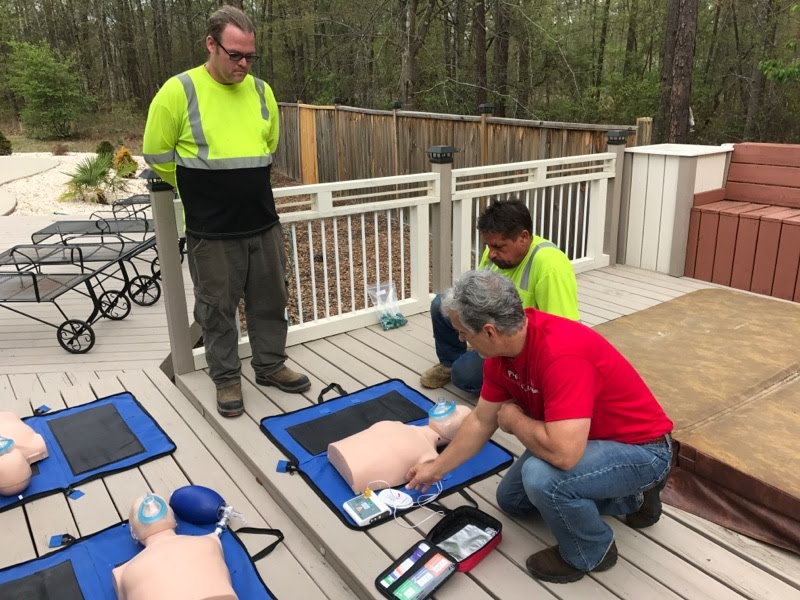
We believe that effective CPR training requires extensive practice. Our courses dedicate significant time to:
- Individual hands-on practice
- Team-based scenarios
- Real-time instructor feedback
- Correction of technique errors
- Building muscle memory for emergency situations
Cardiovascular Health: Prevention Is the Best Medicine
While knowing CPR is crucial, preventing cardiac emergencies is even better. Here’s how comprehensive patient assessment relates to cardiovascular disease prevention:
Early Warning Signs Your Heart May Need Attention
Many cardiac arrests have warning signs hours or even days before the event:
- Chest Discomfort – Pressure, squeezing, fullness, or pain
- Upper Body Pain – Arms, back, neck, jaw, or stomach
- Shortness of Breath – With or without chest discomfort
- Cold Sweats – Sudden perspiration without exertion
- Nausea or Lightheadedness – Unexplained digestive distress or dizziness
- Unusual Fatigue – Especially in women
Risk Factors for Cardiovascular Disease
During a head-to-toe assessment, healthcare providers look for signs of these modifiable risk factors:
- Hypertension – Detected through blood pressure measurement
- High Cholesterol – May be evident through lipid deposits around eyes
- Diabetes – Skin changes, poor wound healing, peripheral neuropathy
- Obesity – Assessed through body habitus inspection
- Smoking – May be evident from skin changes and breath
- Physical Inactivity – Observed through muscle wasting and deconditioning
- Poor Diet – Can manifest in various physical findings
How Regular Assessment Supports Heart Health
Annual physical examinations that include comprehensive head-to-toe assessment help:
- Detect cardiovascular disease early when treatment is most effective
- Monitor existing heart conditions
- Adjust medications based on physical findings
- Identify new risk factors before they cause problems
- Establish baseline measurements for comparison
The Science Behind Effective CPR: What Makes It Work?
Understanding the physiology of CPR helps appreciate why proper technique and early intervention matter:
How CPR Maintains Vital Organ Perfusion
When the heart stops beating effectively, blood no longer circulates oxygen to vital organs. Brain cells begin dying after just 4-6 minutes without oxygen. CPR works by:
- Chest Compressions create artificial circulation by:
- Compressing the heart between the sternum and spine
- Generating pressure that pushes blood through vessels
- Maintaining approximately 25-30% of normal cardiac output
- Delivering oxygenated blood to the brain and heart
- Rescue Breaths provide oxygen by:
- Inflating the lungs with expired air (16% oxygen)
- Oxygenating blood in the lunmonary capillaries
- Supporting gas exchange when spontaneous breathing is absent
The Chain of Survival
The American Heart Association identifies five critical links in the adult Chain of Survival:
- Recognition and Activation – Recognizing cardiac arrest and calling 911
- Early CPR – Beginning chest compressions immediately
- Rapid Defibrillation – Using an AED as soon as available
- Advanced Life Support – EMS providing advanced care
- Post-Arrest Care – Hospital treatment and rehabilitation
Pulse CPR School focuses extensively on links 1-3, which are most critical in the community setting and have the greatest impact on survival.
Compression-Only CPR: When Is It Appropriate?
Recent research shows that compression-only CPR (without rescue breaths) can be effective for adult cardiac arrest victims when:
- The rescuer is untrained or uncomfortable providing breaths
- The arrest was witnessed and sudden
- EMS response time is short
However, traditional CPR with both compressions and breaths remains the gold standard, especially for:
- Drowning victims
- Drug overdoses
- Children and infants
- Prolonged cardiac arrest
At Pulse CPR School, we teach both techniques and help students understand when each is most appropriate.
Special Populations: Adapting Assessment and CPR Techniques
Pediatric Considerations
Children are not simply small adults—their physiology requires modified approaches:
Assessment Differences:
- Faster normal heart rates (infants: 100-160 bpm)
- Higher respiratory rates
- Different blood pressure norms
- Unique pediatric assessment triangle
CPR Modifications:
- Use two fingers for infant chest compressions
- One or two hands for child compressions depending on size
- Compression depth: about 1.5 inches for infants, 2 inches for children
- Different compression-to-ventilation ratios for single versus two-rescuer scenarios
Geriatric Considerations
Older adults present unique challenges:
Assessment Considerations:
- Decreased skin elasticity affects skin assessment
- Weaker peripheral pulses may be normal
- Multiple comorbidities complicate clinical picture
- Atypical presentation of cardiac events (especially in diabetics)
CPR Considerations:
- Higher risk of rib fractures during compressions (don’t let this stop you—broken ribs heal, but death doesn’t)
- May have implanted devices (pacemakers, defibrillators)
- DNR (Do Not Resuscitate) orders must be respected when valid documentation exists
Pregnant Patients
Cardiac arrest in pregnancy requires specific modifications:
Assessment Changes:
- Elevated heart rate is normal in pregnancy
- Blood pressure may be lower in second trimester
- Shortness of breath is common
CPR Modifications:
- Manually displace uterus to the left during compressions
- Position patient with slight leftward tilt if possible
- Be prepared for emergent cesarean delivery if resuscitation is unsuccessful after 4 minutes
Real Success Stories: When Training Meets Emergency
Case Study 1: Early Recognition Saves a Life
Maria, a grocery store manager who took our Heartsaver CPR course, noticed a customer exhibiting signs of cardiac distress—pale skin, cold sweats, and clutching his chest. Using her assessment training, she recognized the emergency, called 911, and prepared to begin CPR. The customer’s condition deteriorated to cardiac arrest, but Maria’s immediate high-quality CPR kept him alive until paramedics arrived. He survived with full neurological recovery.
Key Takeaway: Early recognition through proper assessment allowed Maria to act decisively when seconds counted.
Case Study 2: Healthcare Provider Confidence
James, a new registered nurse, responded to a code blue in his hospital unit. Despite the high-stress environment, his BLS training from Pulse CPR School gave him the confidence to:
- Quickly assess the patient’s pulse and breathing
- Begin immediate chest compressions
- Direct other staff members effectively
- Integrate with the advanced care team seamlessly
Key Takeaway: Comprehensive training builds confidence that translates into effective action during real emergencies.
Case Study 3: Community Impact
After a local church hosted a group CPR training session with Pulse CPR School, three members used their skills within six months:
- One performed CPR on a family member at home
- Another assisted at a community event
- The third helped a neighbor experiencing cardiac arrest
Key Takeaway: Widespread CPR training creates a safety net throughout the community, increasing survival rates for everyone.
Frequently Asked Questions About CPR Training and Cardiac Assessment
How Long Does CPR Certification Last?
Most CPR certifications (BLS, Heartsaver, ACLS, PALS) are valid for two years from the date of course completion. Recertification is required to maintain your credential.
Do I Need to Be in Healthcare to Take a CPR Course?
Absolutely not! While we offer healthcare provider courses, our Heartsaver CPR AED class is designed specifically for non-medical individuals. Everyone should know CPR—emergencies don’t discriminate.
What If I’m Afraid I’ll Do Something Wrong During an Emergency?
This is a common concern, but remember: any attempt at CPR is better than no attempt. You cannot make a dead person more dead. The worst thing you can do is nothing. Our training builds confidence through extensive practice so you’ll feel prepared when it matters.
How Much Does CPR Certification Cost?
Course fees vary depending on the certification level and format. Contact Pulse CPR School at (706) 901-7277 for current pricing and available discounts for groups, students, or community organizations.
Can I Take CPR Training Online?
While some courses offer online components, hands-on practice is essential for effective CPR training. The American Heart Association requires in-person skills testing for all certifications. We offer blended learning options that combine online coursework with in-person skills sessions.
What Should I Bring to My CPR Class?
Simply bring:
- Photo identification
- Comfortable clothing
- Willingness to learn and practice
- Any required course materials (we’ll notify you in advance)
Is the Training Physically Demanding?
CPR practice does require kneeling and performing chest compressions, which can be tiring. However, we accommodate participants with physical limitations and can suggest modifications. Contact us before your class if you have concerns.
What Happens If I Don’t Pass the Course?
Our instructors work closely with each student to ensure competency. If additional practice is needed, we offer remediation at no extra charge. Our goal is your success—we want you to feel confident performing CPR.
The Future of CPR and Emergency Cardiac Care
Technological Advances Improving Outcomes
Emergency cardiac care continues evolving with innovations like:
CPR Feedback Devices – Provide real-time guidance on:
- Compression depth and rate
- Full chest recoil between compressions
- Hand position accuracy
- Ventilation volume
Mobile AED Apps – Help locate nearby AEDs and guide users through operation
Telephonic CPR Assistance – 911 dispatchers provide step-by-step CPR instructions until help arrives
Mechanical CPR Devices – Used by EMS to provide consistent compressions during transport
Advanced Monitoring – Allows EMS to see cardiac rhythms remotely and prepare for arrival
Pulse CPR School Stays Current
We continuously update our curriculum to reflect:
- Latest American Heart Association guidelines
- Emerging research on resuscitation
- New technologies in emergency care
- Best practices from the field
When you train with us, you’re learning the most current, evidence-based techniques available.
Take Action Today: Enroll in a Life-Saving Course
Don’t Wait Until It’s Too Late
Statistics show that:
- 88% of cardiac arrests occur at home
- You’re most likely to need CPR for someone you love
- Bystander CPR doubles or triples survival rates
- Most Americans live within 4 minutes of someone who will have a cardiac arrest this year
The question isn’t whether CPR training is important—it’s whether you’ll have the skills when someone you love needs them.
Easy Enrollment Process
Getting certified is simple:
- Call or Visit – Contact us at (706) 901-7277 or stop by 110 Davis Rd, Martinez, GA 30907
- Choose Your Course – We’ll help you select the right certification for your needs
- Select Your Date – Pick a class time that fits your schedule
- Complete Training – Attend your class and practice hands-on skills
- Receive Certification – Get your official American Heart Association card
Group and Corporate Training Available
Pulse CPR School offers customized training for:
- Medical offices and clinics
- Schools and daycare centers
- Fitness centers and gyms
- Corporate offices
- Churches and community organizations
- Sports teams and athletic departments
Contact us for group rates and on-site training options.
Beyond CPR: Building a Heart-Healthy Community
Our Commitment to Martinez and the CSRA
Pulse CPR School isn’t just a training center—we’re committed to improving cardiovascular health throughout the Central Savannah River Area (CSRA). We participate in:
- Community health fairs
- School safety programs
- Free CPR awareness demonstrations
- Heart health education initiatives
- Partnership with local healthcare providers
Your Role in Community Health
By becoming CPR certified, you join a network of trained responders making our community safer. Consider:
- Encouraging family members to get certified
- Advocating for AEDs in public spaces
- Volunteering to teach CPR awareness
- Supporting cardiovascular health initiatives
- Sharing your knowledge with others
Final Thoughts: Knowledge Saves Lives
The head-to-toe assessment framework isn’t just for healthcare professionals—it’s a systematic approach to understanding human health that anyone can learn. When combined with CPR training, these skills create a powerful toolkit for recognizing and responding to cardiac emergencies.
At Pulse CPR School, we believe that education is empowerment. Every person we train represents potentially saved lives—family members, friends, coworkers, and community members who will benefit from someone knowing what to do when emergency strikes.
The Time to Learn Is Now
Cardiac emergencies don’t schedule appointments. They happen suddenly, without warning, to people of all ages and backgrounds. When that moment comes, will you be ready?
Don’t let fear or uncertainty stop you from learning skills that could save a life. Join us at Pulse CPR School and become the difference between tragedy and survival.
Contact Pulse CPR School Today
Address:
110 Davis Rd
Martinez, GA 30907
Phone:
(706) 901-7277
Office Hours:
Monday – Friday: 8:00 AM – 6:00 PM
Saturday: 9:00 AM – 3:00 PM
Sunday: Closed (Private group training available by appointment)
Follow Us on Social Media:
Stay updated on class schedules, heart health tips, and community events by following Pulse CPR School on Facebook, Instagram, and LinkedIn.
Keywords for SEO Optimization
CPR training Martinez GA, CPR certification near me, BLS certification Augusta, ACLS training Martinez, PALS certification Georgia, American Heart Association CPR, CPR classes Martinez, first aid training CSRA, healthcare provider CPR, Heartsaver CPR, AED training, cardiac assessment, patient assessment skills, emergency response training, life-saving skills, CPR school Augusta GA, medical certification Martinez, nurse CPR renewal, EMT training Georgia, cardiac health, heart attack recognition, stroke assessment, emergency medical training, CPR instructor Martinez, group CPR training, corporate CPR classes, on-site CPR training, weekend CPR classes, CPR certification cost, how to perform CPR, cardiac arrest response, sudden cardiac arrest, bystander CPR, compression-only CPR, hands-only CPR, rescue breathing, automated external defibrillator, chain of survival, cardiovascular health, heart disease prevention, pulse assessment, blood pressure monitoring, head-to-toe assessment, physical examination, nursing assessment skills, medical professional training, healthcare continuing education, ACLS recertification, BLS renewal, PALS recertification
Learn head-to-toe patient assessment and get CPR certified at Pulse CPR School in Martinez, GA. American Heart Association courses for healthcare providers and the community. Call (706) 901-7277 to save lives today.
This comprehensive guide was created by Pulse CPR School to educate the community about the vital connection between patient assessment, cardiovascular health, and life-saving CPR skills. For personalized training that could help you save a life, contact us today.