
Physical Therapy CPR Certification: Georgia Requirements
Meta Description: Complete guide to CPR requirements for physical therapists in Georgia. Learn which BLS certification PTs, PTAs, and PT students need, state licensing requirements, and where to get certified in Augusta. Call 706-901-7277.
Quick Answer: Do Physical Therapists Need CPR Certification in Georgia?
Yes. All physical therapists (PTs), physical therapist assistants (PTAs), and PT students in Georgia must maintain current CPR certification. The Georgia Board of Physical Therapy requires:
- American Heart Association (AHA) BLS for Healthcare Providers certification
- Or American Red Cross Professional Rescuer CPR certification
- Must be current at time of license application and maintained throughout practice
- 2-year renewal cycle required
- Online-only certifications are NOT accepted
Need BLS certification in Augusta? Pulse CPR and First Aid School offers same-day AHA certification for physical therapy professionals. Book your class or call 706-901-7277.
Georgia Physical Therapy Board CPR Requirements
State Licensing Mandates
According to the Georgia Code § 43-33-18 and Georgia Board of Physical Therapy rules:
For Initial PT License Application:
- Current CPR certification from AHA or American Red Cross
- Hands-on skills verification required
- Must be valid healthcare provider-level certification
- Photocopy of certification card submitted with application
For PT License Renewal:
- Current CPR certification must be maintained
- Proof may be requested during random audits
- Expired certification can result in license suspension
- No grace period for expired CPR credentials
For Physical Therapist Assistants (PTAs):
- Same CPR requirements as licensed PTs
- Must be current before taking board exam
- Required for initial certification and renewal
- Documentation kept on file with employing facility
What “Healthcare Provider Level” Means
The Georgia PT Board specifies healthcare provider level CPR, which means:
✅ AHA BLS for Healthcare Providers – Most commonly required
✅ American Red Cross CPR for Healthcare Providers – Also accepted
❌ Heartsaver CPR/AED – NOT sufficient (this is for laypersons)
❌ Online-only certifications – NOT accepted by Georgia licensing board
Why the distinction matters: Healthcare provider CPR includes two-rescuer scenarios, bag-valve-mask ventilation, and team dynamics—skills essential for clinical practice environments.
Why Physical Therapists Need CPR Training
Clinical Scenarios Where PTs Use CPR Skills
Physical therapists encounter medical emergencies more often than you might think:
1. Cardiac Events During Therapy
- High-intensity rehabilitation exercises can trigger cardiac episodes
- Patients with cardiovascular history are at elevated risk
- Outpatient orthopedic patients may have unknown heart conditions
- Post-surgical patients undergoing aggressive mobility training
2. Respiratory Emergencies
- Pulmonary rehabilitation patients at risk for respiratory distress
- COPD patients during exercise-based therapy
- Post-operative patients with compromised respiratory function
- Choking incidents in geriatric populations
3. Neurological Events
- Stroke patients may experience secondary events during therapy
- Seizures leading to respiratory compromise
- Loss of consciousness during vestibular rehabilitation
- Vasovagal responses during pain management procedures
4. Trauma & Falls
- Elderly patients falling during gait training
- Athletes sustaining severe injuries during sports rehab
- Head injuries during balance training
- Fractures or dislocations during manual therapy
Real Statistics from PT Practice Settings
According to the American Physical Therapy Association (APTA):
- 12-15% of PTs report using CPR skills during their career
- 3-5% report responding to cardiac emergencies in clinical setting
- Outpatient orthopedic settings have lower emergency rates than inpatient
- Cardiac rehab PTs have highest likelihood of emergency response scenarios
Bottom line: While emergencies are relatively rare, when they occur, patients’ lives depend on immediate, competent PT response.
CPR Requirements by PT Practice Setting in Augusta
Augusta University Medical Center – Inpatient Rehabilitation
CPR Requirements:
- AHA BLS for Healthcare Providers (mandatory)
- ACLS preferred for acute care PT staff
- Certification verified before hire date
- Annual competency assessments
- Code team participation training
Patient population:
- Post-stroke rehabilitation
- Traumatic brain injury recovery
- Spinal cord injury patients
- Post-cardiac surgery mobility
Emergency preparedness: Higher acuity means PTs must be ready to respond as part of hospital code teams.
Outpatient Orthopedic & Sports Medicine Clinics
CPR Requirements:
- AHA BLS for Healthcare Providers required
- Must be current at all times during practice
- Renewal tracked by clinic manager/owner
- Staff training on emergency action plans
- AED accessible in clinic
Common emergencies:
- Cardiac events during strenuous exercise
- Choking (elderly patients, athletes)
- Heat-related emergencies (athletes)
- Allergic reactions (rare but possible)
Augusta-area examples:
- OrthoGeorgia Sports Medicine
- Doctors Hospital Rehab Services
- Augusta Sport & Spine
- Private practice PT clinics
Home Health Physical Therapy
CPR Requirements:
- AHA BLS certification (non-negotiable)
- Must present current card to agency before patient visits
- Solo responder training emphasized
- Emergency protocol documentation required
Unique challenges:
- No immediate backup from other healthcare providers
- Patients often have complex medical histories
- Access to emergency equipment limited
- May need to direct family members during emergencies
Augusta home health agencies requiring CPR:
- Amedisys Home Health
- Kindred at Home
- Augusta Home Health
- Private practice home PT services
Skilled Nursing Facilities & Long-Term Care
CPR Requirements:
- AHA BLS for Healthcare Providers required
- Annual facility-specific code response training
- Documentation of emergency response drills
- Integration with facility emergency protocols
Resident populations:
- Elderly post-hospitalization rehabilitation
- Dementia/Alzheimer’s patients
- Hospice/palliative care (modified protocols)
- Complex medical conditions
Augusta-area SNFs employing PTs:
- Trinity Hospital Transitional Care Unit
- Brandon Wilde Retirement Community
- Benton House of Augusta
- Multiple assisted living facilities
School-Based Physical Therapy
CPR Requirements:
- AHA BLS or Heartsaver CPR/AED (depends on school district)
- Required for all itinerant PTs serving schools
- Annual school safety training
- Coordination with school nurses
Special considerations:
- Pediatric CPR skills essential
- AED locations in schools
- Communication with parents during emergencies
- Integration with school emergency action plans
PT School Requirements: Getting Certified Before Graduation
Augusta University Doctor of Physical Therapy (DPT) Program
CPR Certification Timeline:
Before First Clinical Rotation:
- AHA BLS for Healthcare Providers required
- Must submit proof of certification to Clinical Education office
- Certification must remain current throughout entire DPT program
- Students responsible for renewal if expires during studies
Program Duration Considerations:
- DPT program: 3 years (certification expires once during program)
- Budget for mid-program renewal (~$69)
- Schedule renewal during break periods or before clinical intensives
Clinical Rotation Requirements:
- Each clinical site verifies current CPR certification
- Some sites require 6+ months validity remaining
- Expired certification = inability to complete clinical hours
- Program progression depends on current certification status
Graduation Requirement:
- Current BLS certification confirmed before degree conferral
- Certification card submitted to registrar
- Needed for PT board exam application in Georgia
Application to Georgia PT Licensing Exam
Before Taking the NPTE (National Physical Therapy Examination):
Georgia requires proof of CPR certification as part of licensure application to:
- Federation of State Boards of Physical Therapy (FSBPT)
- Georgia Board of Physical Therapy
Documentation needed:
- Copy of current AHA BLS or ARC CPR card (front and back)
- Certification must be current on date of application
- Digital cards accepted in most cases
- Original or certified copy may be requested
Timeline tip: Get certified 3-6 months before graduation to ensure documentation is ready for immediate post-graduation board application.
BLS for Healthcare Providers: What PTs Learn
Course Content Specific to PT Practice
Adult CPR & Choking:
- Compression depth: 2-2.4 inches (critical for effective circulation)
- Compression rate: 100-120 per minute
- Full chest recoil between compressions
- Minimizing interruptions (hands-off time <10 seconds)
- Heimlich maneuver for conscious choking patients
Pediatric CPR (Essential for Pediatric PTs):
- Modified compression technique for children
- Two-thumb encircling technique for infants
- Age-appropriate compression depth
- Pediatric choking relief procedures
Two-Rescuer CPR:
- Communication protocols with other staff
- Switching roles without interrupting CPR
- Coordinating with emergency medical services
- Team dynamics in clinic emergencies
AED Use:
- Rapid deployment in clinic settings
- Pad placement considerations
- Safety during shock delivery
- Special situations: pacemakers, medication patches, wet patients
Bag-Valve-Mask (BVM) Ventilation:
- Two-person BVM technique
- Proper mask seal
- Appropriate ventilation rate
- Avoiding excessive ventilation (gastric distension)
Special Scenarios for PTs:
- Patient on treatment table vs. floor
- Moving patient safely if not on appropriate surface
- Using clinic resources during emergencies
- Integrating family members present during therapy
How Often Do PTs Need to Renew BLS?
2-Year Certification Cycle
AHA BLS Certification Validity: 2 years from issue date
Renewal best practices for PTs:
Timing Strategy:
- Renew 60-90 days before expiration
- Coordinate with license renewal period
- Schedule during typically slower clinic periods
- Book weekend or evening classes to avoid missing work
Why Not Wait Until Last Minute:
- Class availability may be limited
- Unexpected illness could cause you to miss class
- Card processing takes 2-5 business days
- Employers may have stricter deadlines than expiration date
Consequences of Lapsed Certification:
- Cannot practice until recertified
- Must retake full initial course (not shorter renewal)
- Potential state board investigation
- Liability if emergency occurs while certification expired
Tracking Multiple Staff Certifications
For PT clinic owners/managers:
Best practices for tracking staff CPR:
- Maintain spreadsheet with all staff expiration dates
- Set reminders 90 days before each expiration
- Schedule group renewal classes for entire staff
- Budget for annual CPR training expenses
- Include CPR status in performance reviews
Consider group training: Pulse CPR School offers on-site training for PT clinics with 5+ staff members. Call 706-901-7277 for group pricing.
Where Physical Therapists Get Certified in Augusta
Pulse CPR and First Aid School – Top Choice for Augusta PTs
📍 Location: 110 Davis Rd, Suite 18, Martinez, GA 30907
📞 Phone: 706-901-7277
💻 Website: pulsecprschool.com
Why Physical Therapists Choose Pulse:
✅ Same-day AHA BLS certification – Get your card immediately
✅ Evening & weekend classes – Don’t miss patient appointments
✅ Experienced instruction – John has trained 20,000+ healthcare providers
✅ Group discounts – Bring your whole clinic staff
✅ Flexible scheduling – 7 days/week, 8 AM-9 PM
✅ Convenient location – Easy access from I-20, serves Augusta, Evans, Martinez, Grovetown
Pricing for PTs:
- BLS Provider Certification: $69.00
- BLS Renewal: $69.00
- Group rates: Available for 5+ therapists
Class format:
- 3-4 hours total (including breaks)
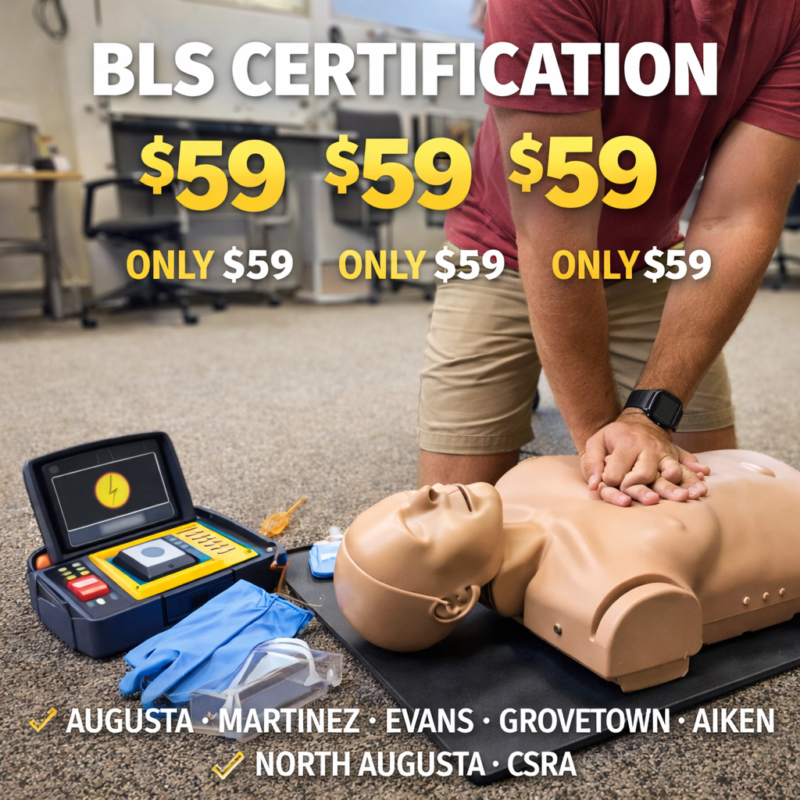
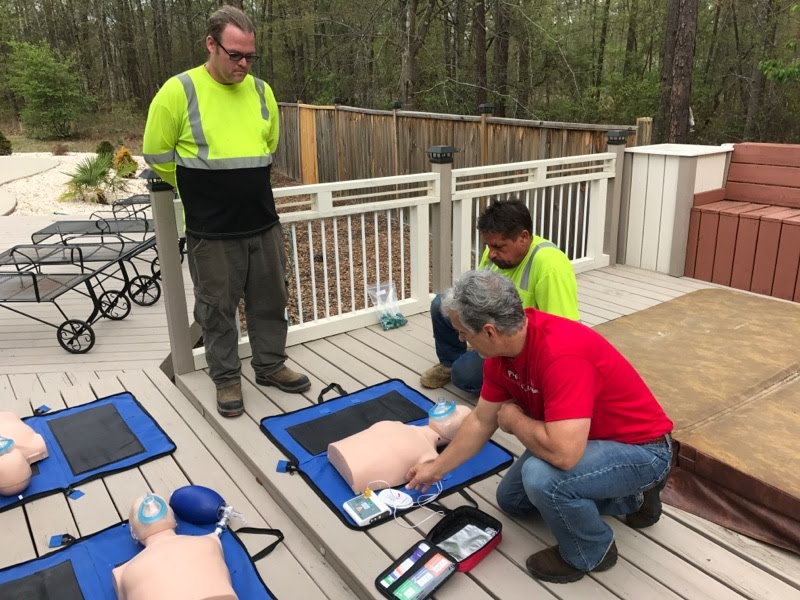
- Hands-on practice with professional manikins
- Skills assessment and written exam
- Walk out with your AHA certification card
Other Augusta Training Options
Augusta University (for AU students/staff primarily):
- Limited public class availability
- Higher cost than community training sites
- Convenient if already on campus
Hospital in-service training:
- Available only to hospital-employed PTs
- Typically during orientation or annual competency days
- Not an option for outpatient/private practice therapists
American Red Cross:
- Alternative to AHA certification (both accepted by GA PT Board)
- Less frequent class schedule in Augusta
- Different course format and materials
Online + Skills Session (HeartCode BLS):
- Complete cognitive portion online at your pace
- Attend abbreviated in-person skills session
- Same valid AHA BLS card issued
- Available through Pulse CPR School – call for details
Cost Analysis: CPR Certification for PTs
What You’ll Pay in Augusta
Standard Pricing:
- Initial BLS certification: $59-$89
- BLS renewal: $59-$89
- HeartCode BLS (blended): $75-$110
At Pulse CPR School: $69.00 flat rate (all-inclusive, no hidden fees)
What’s Included in Your Fee
Your $69 BLS course fee covers:
✅ 3-4 hours of expert instruction
✅ AHA BLS Provider manual and materials
✅ Professional-grade CPR manikins for practice
✅ AED trainer units
✅ Skills assessment by certified instructor
✅ Written examination
✅ Official AHA digital eCard (emailed same day)
✅ Physical BLS card (mailed within 5 days)
✅ 2-year certification validity
✅ Free retest if needed (99.8% first-time pass rate)
No surprise fees for materials, testing, or card issuance.
Is CPR Training Tax Deductible for PTs?
Yes! CPR certification is a deductible professional expense:
As an employee PT:
- Deduct on Schedule A if itemizing deductions
- Considered continuing education/professional development
- Include mileage to/from training center
As a self-employed PT or clinic owner:
- Deduct on Schedule C as business expense
- Include certification costs for all staff
- Full deduction for group training expenses
Documentation needed:
- Receipt from training center
- Date and purpose of certification
- Business connection (required for licensure)
Consult your CPA about specific tax treatment for your situation.
Employer Reimbursement
Does your employer reimburse CPR certification?
Many PT employers offer:
- 100% reimbursement upon course completion
- Annual continuing education allowance (CPR qualifies)
- Direct payment to training center for group classes
- Paid time off for required training
Ask your clinic manager or HR department about reimbursement policies before paying out of pocket.
Scheduling CPR Training Around Your PT Practice
Best Times for PTs to Get Certified
For New Graduate PTs:
- During final semester of PT school (before graduation)
- Immediately after graduation (before board exam application)
- Before starting clinical job search
For Working PTs:
- Weekend classes (Pulse offers Saturday & Sunday)
- Early morning classes before clinic opens
- Evening classes after last patient
- During planned PTO or vacation days
- Slow clinic periods (typically late November-December)
Group Certification for Your PT Clinic
Planning staff training for your entire clinic?
Benefits of group BLS classes:
- Cost savings (group discounts available)
- Team building and shared experience
- Coordinated renewal schedules
- Clinic closed for half-day = all staff certified
Pulse CPR offers on-site training:
- We come to your clinic with all equipment
- Schedule around your patient schedule
- Train 5-50 therapists in single session
- Same AHA certification as in-person classes
Contact us for group quote: 706-901-7277 or pulsecpr967@gmail.com
Common Questions from Physical Therapists
Can I take CPR certification online?
Partially. The AHA offers HeartCode BLS, which includes:
- Online cognitive learning (1-2 hours at your pace)
- In-person skills session (1-2 hours at training center)
You cannot complete 100% online and meet Georgia PT Board requirements. Hands-on skills verification is mandatory.
Pulse CPR School offers HeartCode BLS – complete the online portion on your schedule, then come in for skills testing. Call 706-901-7277 for details.
What if my BLS expires while I’m on leave (maternity, medical, etc.)?
You must renew before returning to patient care. Georgia law prohibits practicing with expired CPR certification.
Plan ahead:
- Schedule renewal class before leave if possible
- Budget time during leave for 3-4 hour class
- Coordinate with employer about return-to-work requirements
Pulse CPR advantage: Our flexible schedule accommodates PTs returning from leave. Evening and weekend options available.
Do I need ACLS in addition to BLS?
It depends on your practice setting:
BLS only (required for all PTs):
- Outpatient orthopedic clinics
- Private practice PT
- School-based therapy
- Most home health settings
ACLS may be required:
- Acute care hospital PTs
- ICU/CCU physical therapy
- Cardiac rehabilitation programs
- Emergency department PTs
Start with BLS – it’s the foundation and required by GA licensing board. Your employer will specify if ACLS is needed for your specific role.
What’s the difference between BLS and Heartsaver CPR?
BLS for Healthcare Providers (required for PT licensure):
- Two-rescuer CPR scenarios
- Bag-valve-mask ventilation
- Team dynamics and communication
- Healthcare-specific emergency response
- Higher level of competency expected
Heartsaver CPR/AED (layperson level):
- Single-rescuer CPR only
- Basic rescue breathing
- Community/workplace emergencies
- Not accepted by Georgia PT Board
PTs must have BLS – Heartsaver is insufficient for licensure requirements.
Can I use my CPR certification from another state?
Yes, if it meets Georgia requirements:
✅ American Heart Association BLS – Accepted from any state
✅ American Red Cross CPR for Healthcare Providers – Accepted from any state
✅ Current (not expired) – Must be valid at time of GA application
✅ Healthcare provider level – Layperson CPR not sufficient
Transferring to Georgia from another state? As long as your AHA BLS card is current, Georgia will accept it. No need to recertify until your regular renewal date.
What if I fail the BLS skills test?
Failure is rare (Pulse CPR School has 99.8% pass rate), but if it happens:
Immediate remediation:
- Instructor identifies specific skills needing improvement
- Additional practice time provided
- Retest same day (no additional charge)
If further practice needed:
- Return within 30 days for retest
- 50% discount on full class if complete retake needed
- Personal coaching from instructor
Most common skill challenges:
- Compression depth (too shallow)
- Compression rate (too fast or slow)
- Not allowing full chest recoil
- Improper hand placement
Instructor John’s approach: Hands-on coaching until every student demonstrates competency. We don’t move forward until you’re confident and capable.
How soon before my expiration should I renew?
Optimal renewal window: 60-90 days before expiration
Why not sooner:
- Your new certification is dated from class completion date
- Renewing 6+ months early means you “lose” time on current certification
Why not later:
- Class availability may be limited
- Risk of forgetting and lapsing
- Employer may require renewal 30 days before expiration
- Georgia Board audits could catch expired certification
Pro tip: Set a calendar reminder 90 days before expiration. This gives you plenty of scheduling flexibility.
PT-Specific Emergency Scenarios: Case Studies
Case Study 1: Cardiac Event During Outpatient Rehab
Scenario:
67-year-old male undergoing post-knee replacement rehabilitation. During stair climbing exercise (moderately strenuous), patient clutches chest, becomes pale, and collapses.
PT Response Using BLS Skills:
- Recognition: Check responsiveness and breathing
- Activation: Direct staff to call 911 and get AED
- Circulation: Begin chest compressions (30:2 ratio)
- AED: Apply pads, analyze rhythm, deliver shock if advised
- Continuation: Continue CPR until EMS arrives
- Documentation: Record time of event, interventions, patient response
Outcome: Patient survived due to immediate PT response. Unknown cardiac history made event unpredictable.
Lesson: Even “routine” orthopedic patients can experience cardiac emergencies. BLS skills save lives.
Case Study 2: Choking in Skilled Nursing Facility
Scenario:
82-year-old female with dysphagia receiving PT for post-stroke mobility. During therapy session, begins choking on water given after exercise.
PT Response Using BLS Skills:
- Assessment: Determine if partial or complete airway obstruction
- Conscious choking protocol: Back blows and abdominal thrusts (Heimlich)
- Progression to unconscious: If patient loses consciousness, begin CPR
- Airway check: Look for object during CPR cycles
- Continuation: CPR until obstruction cleared or EMS arrives
Outcome: Obstruction cleared after 3 abdominal thrusts. Patient recovered fully.
Lesson: Dysphagia + physical exertion = heightened choking risk. PTs working with stroke patients must maintain current CPR skills including choking relief.
Case Study 3: Respiratory Distress in Home Health
Scenario:
COPD patient receiving home PT for deconditioning. During ambulation training, experiences severe shortness of breath and becomes unresponsive.
PT Response Using BLS Skills:
- Scene safety: Assess environment (oxygen tanks, clear path for EMS)
- Responsiveness: Check patient, call 911 immediately (solo responder)
- Positioning: Place patient on firm surface
- CPR: Begin compressions (patient has no pulse)
- AED: Use patient’s home AED if available
- Direction: Direct family members to meet EMS at door
Outcome: Patient regained pulse before EMS arrival. Hospitalized and recovered.
Lesson: Home health PTs often work alone. BLS skills + calm decision-making + family coordination = life saved.
Staying Current: Beyond CPR Certification
Continuing Education Related to Emergency Response
APTA Resources for PTs:
- Emergency preparedness webinars
- Case studies on PT emergency response
- Risk management education
- Clinical decision-making in emergencies
Additional Certifications to Consider:
- ACLS (Advanced Cardiovascular Life Support) – For acute care PTs
- PALS (Pediatric Advanced Life Support) – For pediatric PTs
- First Aid certification – Complements BLS skills
- Stop the Bleed training – Trauma response skills
Clinic Emergency Action Plans
Every PT clinic should have:
✅ Written emergency action plan
- Step-by-step response protocols
- Staff roles and responsibilities
- Emergency contact numbers
- Equipment locations (AED, first aid kit)
✅ Regular emergency drills
- Practice mock cardiac arrest scenarios
- Time response from recognition to EMS arrival
- Identify gaps in protocols or equipment
✅ AED readily accessible
- Within 3-minute retrieval time
- All staff trained on location and use
- Regular battery and pad checks
✅ Emergency supplies
- Pocket mask or face shield
- Gloves (universal precautions)
- First aid kit
- Phone for calling 911
Pulse CPR School tip: During our BLS classes, we discuss clinic-specific emergency planning. Ask instructor John about developing emergency protocols for your practice.
Maintaining Your Competitive Edge as a PT
CPR Certification on Your Resume
Include on your PT resume:
- “Current AHA BLS for Healthcare Providers (expires MM/YYYY)”
- List under “Certifications” or “Licenses & Credentials” section
- Update expiration date after each renewal
- Remove outdated certifications
Job application tips:
- Upload copy of BLS card with application materials
- Mention in cover letter if recently renewed
- Highlight if you have additional certifications (ACLS, PALS)
Patient & Family Confidence
Marketing angle for private practice PTs:
“Our entire staff maintains current CPR and emergency response certification. Your safety during rehabilitation is our top priority.”
Why it matters:
- Builds patient trust
- Differentiates your practice from competitors
- Demonstrates professionalism
- Reduces liability concerns
Display certifications:
- Frame AHA Training Center completion certificates in waiting area
- Include CPR certification status on website
- Mention in new patient paperwork
- Reference during patient orientation
Ready to Get BLS Certified in Augusta?
Physical therapists throughout the Augusta area trust Pulse CPR and First Aid School for their BLS certification and renewal needs. With same-day certification, flexible scheduling, and expert instruction from John (20,000+ healthcare providers trained), you can maintain your Georgia PT license requirements confidently.
Next Steps:
- Check your current BLS expiration date (if already certified)
- Choose a convenient class time (evenings, weekends, weekdays available)
- Register online in 2 minutes at pulsecprschool.com/classes
- Attend your 3-4 hour class (no prep required)
- Receive your AHA BLS card same day
Book Your BLS Certification Today
📍 Location: 110 Davis Rd, Suite 18, Martinez, GA 30907
📞 Phone: 706-901-7277
📧 Email: pulsecpr967@gmail.com
🕐 Hours: Monday-Sunday, 8 AM–9 PM
💳 Price: $69.00 (all-inclusive, no hidden fees)
Group Training for PT Clinics
Need to certify your entire staff?
Pulse CPR School provides on-site BLS training for physical therapy clinics throughout the Augusta area:
✅ We bring all equipment to your clinic
✅ Schedule around your patient appointments
✅ Train 5-50 therapists in single session
✅ Group discounts available
✅ Same AHA BLS certification
Call 706-901-7277 for a customized group training quote.
Additional Resources for Georgia Physical Therapists
Georgia Board of Physical Therapy
- Website: sos.ga.gov/PLB/pt
- License verification: verify.sos.ga.gov/verification
- Phone: 404-207-1440
- Email: plb@sos.ga.gov
American Physical Therapy Association (APTA)
- National website: apta.org
- Georgia chapter: gpta.org
- Emergency preparedness resources: apta.org/patient-safety
American Heart Association
- CPR course information: cpr.heart.org
- Find your digital eCard: ecard.heart.org
- 2020 CPR Guidelines: eccguidelines.heart.org
Augusta University DPT Program
- Website: augusta.edu/pt
- Program information: 706-721-2141
About Pulse CPR and First Aid School: We’re an American Heart Association Training Center proudly serving physical therapists, healthcare providers, and community members throughout Augusta, Martinez, Evans, Grovetown, and the CSRA. With over 20,000 students trained and 468 five-star reviews, we’re the trusted choice for BLS certification. Our mission is to provide high-quality, accessible life-saving training that builds confidence and competence in every healthcare professional we serve.
Last updated: December 2025
Keywords: Physical therapy CPR requirements Georgia, BLS for physical therapists Augusta, PT license CPR certification, physical therapist assistant BLS, Augusta PT CPR training, Georgia Board of Physical Therapy requirements, healthcare provider CPR Martinez GA, PT student BLS certification