
BLS Sample Test – Free Practice Questions
Master Basic Life Support with our comprehensive practice exam
Welcome to Our BLS Sample Test
This comprehensive Basic Life Support (BLS) practice test contains 50 questions designed to help you prepare for your BLS certification exam. Our questions follow the latest American Heart Association (AHA) guidelines and cover all essential BLS topics including CPR, AED use, choking relief, and team-based resuscitation.
Contact Pulse CPR School
Training Center: Pulse CPR School
Phone: (706) 901-7277
Email: pulsecpr967@gmail.com
Address: 110 Davis Rd Suite #18, Martinez, GA 30907
BLS Practice Test Questions
Question 1: What is the correct compression rate for adult CPR?
According to AHA guidelines, chest compressions should be performed at a rate of 100-120 compressions per minute for all ages.
Question 2: What is the correct compression depth for adult CPR?
For adult CPR, compressions should be at least 2 inches (5 cm) deep but no more than 2.4 inches (6 cm).
Question 3: What is the compression-to-ventilation ratio for single-rescuer adult CPR?
The compression-to-ventilation ratio for single-rescuer adult CPR is 30:2.
Question 4: When should you switch compressors during CPR?
To prevent fatigue and maintain effective compressions, rescuers should switch every 2 minutes.
Question 5: What is the first step in the BLS sequence?
The first step is to check for responsiveness by tapping the shoulders and shouting, then check for normal breathing.
Question 6: How long should each rescue breath take?
Each rescue breath should take 1 second and make the chest rise visibly.
Question 7: Where should AED pads be placed on an adult?
Place one pad on the upper right chest and the other on the lower left side of the chest.
Question 8: What should you do if the victim vomits during CPR?
If vomiting occurs, turn the victim to the side, clear the airway, return to supine position, and resume CPR.
Question 9: What is the compression depth for infant CPR?
For infant CPR, compressions should be at least 1.5 inches (4 cm) deep.
Question 10: How many fingers should you use for infant chest compressions?
Use 2 fingers for single-rescuer infant CPR, placed just below the nipple line.
Question 11: What is the compression-to-ventilation ratio for 2-rescuer infant CPR?
For 2-rescuer infant and child CPR, the ratio is 15:2.
Question 12: When should you use an AED on a child?
Use an AED as soon as it becomes available for any child in cardiac arrest.
Question 13: What should you do for a conscious choking adult?
For conscious choking adults, perform abdominal thrusts (Heimlich maneuver).
Question 14: What should you do for a conscious choking infant?
For conscious choking infants, alternate between 5 back blows and 5 chest thrusts.
Question 15: How often should you check for a pulse during CPR?
Don’t interrupt CPR to check for pulse unless the AED is analyzing or the victim shows obvious signs of life.
Question 16: What is the maximum time you should take to check for a pulse?
Take no more than 10 seconds to check for a pulse.
Question 17: Where do you check for a pulse in an adult?
Check for a pulse at the carotid artery in the neck for adults and children.
Question 18: Where do you check for a pulse in an infant?
Check for a pulse at the brachial artery in the upper arm for infants.
Question 19: What does AED stand for?
AED stands for Automated External Defibrillator.
Question 20: When should you NOT use an AED?
Never use an AED on a responsive person. The AED is only for unresponsive victims.
Question 21: What should you do if the AED pads are touching each other?
If AED pads are touching, reposition them so they don’t touch each other.
Question 22: What is the universal sign of choking?
The universal sign of choking is hands clutching the throat.
Question 23: What should you do if an adult becomes unconscious while choking?
If a choking victim becomes unconscious, start CPR. Look for the object before giving rescue breaths.
Question 24: How should you open the airway in an unconscious victim?
Use the head tilt-chin lift maneuver to open the airway in an unconscious victim (unless trauma is suspected).
Question 25: What should you do if you suspect spinal injury?
If spinal injury is suspected, use the jaw thrust maneuver to open the airway.
Question 26: What is the correct hand placement for adult chest compressions?
Place the heel of your hand on the lower half of the breastbone (sternum).
Question 27: How much should the chest recoil between compressions?
Allow complete chest recoil between compressions to allow the heart to fill with blood.
Question 28: What is the proper technique for rescue breathing?
Give steady breaths over 1 second that make the chest rise visibly.
Question 29: What should you do if the chest doesn’t rise during rescue breathing?
If the chest doesn’t rise, reposition the airway and attempt rescue breathing again.
Question 30: What is the age range for pediatric BLS?
Pediatric BLS applies to children from 1 year to puberty (approximately 8 years or 55 pounds).
Question 31: What defines an infant for BLS purposes?
An infant is defined as less than 1 year old for BLS purposes.
Question 32: What is the correct compression depth for child CPR?
For child CPR, compressions should be at least 2 inches (5 cm) deep, same as adults.
Question 33: How should you position an infant for chest compressions?
Place the infant on a firm surface or support on your forearm for effective compressions.
Question 34: What is the recommended method for 2-rescuer infant CPR compressions?
For 2-rescuer infant CPR, use 2 thumbs with hands encircling the chest.
Question 35: What should you do if you are alone and witness a child collapse?
If alone with a child victim, provide 2 minutes of CPR before leaving to call 911.
Question 36: What is the most common cause of cardiac arrest in children?
Respiratory problems are the most common cause of cardiac arrest in children.
Question 37: When using an AED on a child, what should you use if available?
Use pediatric pads if available for children. If not available, use adult pads.
Question 38: What is the minimum number of rescuers needed for effective team resuscitation?
A minimum of 2 rescuers is needed for effective team resuscitation.
Question 39: What is the role of the team leader during resuscitation?
The team leader coordinates the team, assigns roles, and ensures effective communication.
Question 40: What should you do if you notice the chest compressions are not adequate?
Provide constructive coaching and feedback to improve compression quality.
Question 41: What is the correct way to communicate during team resuscitation?
Use clear, direct communication and closed-loop communication during resuscitation.
Question 42: What does “closed-loop communication” mean?
Closed-loop communication means confirming that instructions were heard, understood, and carried out.
Question 43: What should you do if the victim has a pulse but is not breathing?
If the victim has a pulse but is not breathing, provide rescue breathing only.
Question 44: How often should you give rescue breaths to an adult with a pulse?
Give rescue breaths every 5-6 seconds (10-12 breaths per minute) for adults with a pulse.
Question 45: How often should you give rescue breaths to a child with a pulse?
Give rescue breaths every 3-5 seconds (12-20 breaths per minute) for children with a pulse.
Question 46: What is the recovery position used for?
The recovery position is used for unconscious victims who have a pulse and are breathing.
Question 47: What should you do if a victim regains consciousness during CPR?
If the victim regains consciousness, stop CPR and monitor them closely.
Question 48: What is the most important factor in survival from cardiac arrest?
Early CPR is the most important factor in survival from cardiac arrest.
Question 49: What should you do if you’re unsure whether to start CPR?
If you’re unsure whether to start CPR, start CPR. It’s better to do CPR on someone who doesn’t need it than to not do it on someone who does.
Question 50: What is the Chain of Survival?
The Chain of Survival is a series of critical actions that improve the likelihood of survival from cardiac arrest.
Why Choose Pulse CPR School for Your BLS Certification?
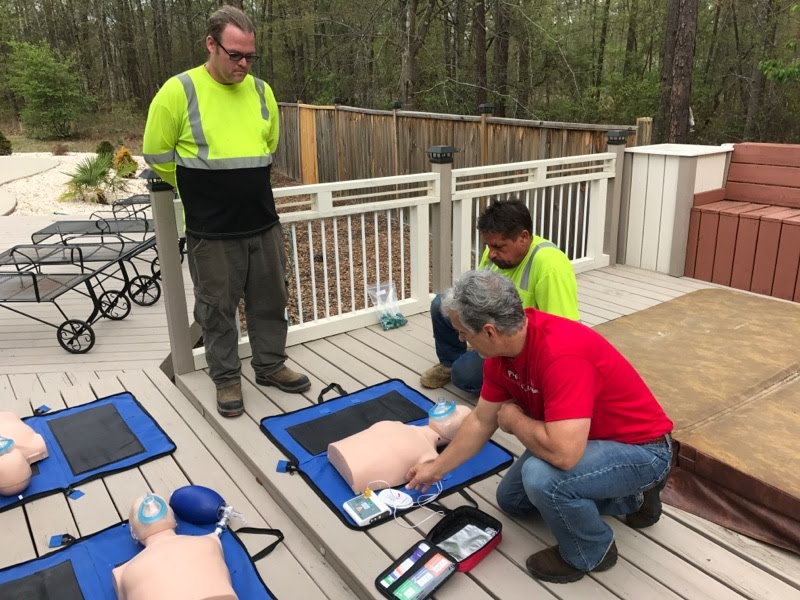
At Pulse CPR School, we provide comprehensive Basic Life Support (BLS) training that meets American Heart Association standards. Our experienced instructors ensure you gain the confidence and skills needed to respond effectively in emergency situations.
Our BLS Training Programs Include:
Our BLS classes cover adult, child, and infant CPR, AED use, and relief of choking. We offer flexible scheduling with both weekday and weekend classes available at our Martinez, GA location. Our hands-on training approach ensures you master the critical skills needed for BLS certification.
What You’ll Learn in Our BLS Course:
Students learn high-quality CPR techniques, proper AED operation, effective team communication during resuscitation, and how to relieve choking in all age groups. Our courses are designed for healthcare professionals, first responders, and anyone requiring BLS certification.
BLS Certification Requirements:
To earn your BLS certification, you must demonstrate competency in all required skills including chest compressions, rescue breathing, AED use, and choking relief. Our certification is valid for two years and meets employer requirements for healthcare workers.