
CPR Requirements for Nurses in Augusta: Everything RNs & CNAs Need to Know in 2026
Meta Description: Complete guide to CPR certification requirements for nurses in Augusta, GA. Learn which BLS certification RNs, CNAs, and LPNs need, renewal deadlines, and where to get certified. Call 706-901-7277.
Quick Answer: What CPR Certification Do Nurses Need in Georgia?
All registered nurses (RNs), licensed practical nurses (LPNs), and certified nursing assistants (CNAs) in Georgia must maintain current American Heart Association (AHA) Basic Life Support (BLS) for Healthcare Providers certification. This certification must be renewed every 2 years and is required for:
- Initial nursing license application
- License renewal
- Employment at hospitals, clinics, and healthcare facilities
- Nursing school enrollment and graduation
- Home health care positions
- Long-term care facilities
Need to get certified or renew? Pulse CPR and First Aid School offers same-day AHA BLS certification in Martinez, GA. Book your class today or call 706-901-7277.
Georgia Nursing Board CPR Requirements
What the Georgia Board of Nursing Requires
The Georgia Board of Nursing mandates that all nursing license applicants and renewals provide proof of current CPR certification. Here are the specific requirements:
For Registered Nurses (RNs):
- AHA BLS for Healthcare Providers certification required
- Must be current at time of license application/renewal
- 2-year certification validity period
- Online-only certifications are NOT accepted for licensure
For Licensed Practical Nurses (LPNs):
- Same AHA BLS for Healthcare Providers certification
- Required for initial licensure and employment
- Must include hands-on skills verification
- Georgia accepts only AHA or American Red Cross certifications
For Certified Nursing Assistants (CNAs):
- AHA BLS or Heartsaver CPR/AED certification acceptable
- Required for certification and most employment
- Skills must include adult, child, and infant CPR
- AED training component mandatory
Why Healthcare Provider BLS vs. Basic CPR?
Many nurses ask: “Can I just take a basic CPR class?” The answer is no – and here’s why:
BLS for Healthcare Providers Includes:
✅ Two-rescuer CPR scenarios (team-based response)
✅ Bag-valve-mask (BVM) ventilation techniques
✅ Opioid-associated life-threatening emergencies
✅ High-quality CPR performance metrics (depth, rate, recoil)
✅ Recognition of cardiac arrest vs. respiratory distress
✅ Integration with advanced life support (ALS) teams
✅ Use of AED in healthcare settings
Basic Heartsaver CPR Only Includes:
- Single-rescuer CPR
- Basic rescue breathing
- AED use for laypersons
- Choking relief
Bottom line: Hospitals, nursing schools, and the Georgia Board of Nursing specifically require BLS for Healthcare Providers because it’s designed for medical professionals who will respond as part of a healthcare team.
Augusta-Area Hospitals & Their CPR Requirements
Augusta University Medical Center
- Required: AHA BLS for Healthcare Providers
- Renewal deadline: 30 days before expiration
- New hires: Must have current certification on first day
- Verification: Digital card accepted, physical card required within 30 days
Doctors Hospital of Augusta
- Required: AHA BLS certification
- Frequency: Every 2 years
- Department-specific: ICU and ER nurses may require ACLS in addition to BLS
- Orientation: Verification required before orientation begins
Charlie Norwood VA Medical Center (Fort Gordon)
- Required: AHA BLS for Healthcare Providers
- Military standards: Must meet DoD requirements
- Contractors: Civilian nurses working with military need same certification
- Renewal tracking: HR monitors expiration dates
University Hospital (formerly MCG Health)
- Required: AHA BLS Provider certification
- Grace period: None – must maintain current status
- Float pool nurses: Required for all units
- Travel nurses: Must provide current card before assignment
Trinity Hospital of Augusta
- Required: AHA BLS certification
- New graduates: Must complete before hire date
- PRN staff: Same requirements as full-time
- Verification: Uploaded to HR portal
Nursing Schools in Augusta: CPR Requirements
Augusta University College of Nursing
Undergraduate Nursing Students (BSN):
- AHA BLS required before first clinical rotation (typically sophomore year)
- Must remain current throughout entire program
- Re-certification required if expires during program
- No online-only certifications accepted
Accelerated BSN Students:
- BLS required within first 2 weeks of program
- Proof submitted with clinical paperwork
- Class schedules available evenings/weekends to accommodate students
Graduate Nursing Students (MSN, DNP):
- Current BLS required for admission
- Advanced practice students may also need ACLS/PALS
- Renewal responsibility falls on student
Augusta Technical College Nursing Program
Practical Nursing (LPN) Program:
- AHA BLS or Heartsaver CPR/AED required before clinical start
- Certification must be valid through program completion
- Skills testing required (not online-only)
Associate Degree Nursing (ADN) Program:
- AHA BLS for Healthcare Providers mandatory
- Required before Nursing 101 clinical component
- Students must budget $69-85 for certification cost
Georgia Military College – Augusta Campus
Nursing Program Requirements:
- AHA BLS certification before clinical rotations
- Military-affiliated students: certification must meet DoD standards
- Recommended: Get certified early in first semester
BLS Certification Class: What Nurses Need to Know
What’s Covered in the 3-Hour BLS Course
Skills Training (Hands-on Practice):
- High-Quality CPR for Adults
- Compression depth: 2-2.4 inches
- Compression rate: 100-120 per minute
- Full chest recoil between compressions
- Minimizing interruptions
- CPR for Children and Infants
- Modified compression techniques
- Appropriate compression depth for age
- Two-thumb encircling technique for infants
- Two-Rescuer Scenarios
- Team dynamics and communication
- Switching roles without interrupting CPR
- Coordinating compressions and ventilations
- Bag-Valve-Mask (BVM) Ventilation
- Proper seal technique
- Two-person BVM operation
- Avoiding excessive ventilation
- AED Use in Healthcare Settings
- Rapid deployment protocols
- Continuing CPR while AED charges
- Special situations (pacemakers, medication patches)
- Relief of Choking
- Conscious vs. unconscious patients
- Abdominal thrusts (Heimlich maneuver)
- Infant choking relief
The Skills Test: What to Expect
Nurses must demonstrate competency in:
- Adult CPR scenario (30 compressions : 2 breaths ratio)
- Infant or child CPR scenario
- AED application and use
- BVM ventilation (2-rescuer)
- Team dynamics during cardiac arrest
Pass rate at Pulse CPR School: 99.8% first-time pass rate for healthcare providers.
Written Exam Details
- Format: Multiple choice
- Questions: 25 questions
- Passing score: 84% (21 correct answers)
- Time limit: Untimed (typically 20-30 minutes)
- Topics covered: Recognition, CPR technique, AED use, safety
Study tip: Focus on compression depth/rate, when to use AED, and team communication scenarios.
How Often Do Nurses Need to Renew BLS?
Standard Renewal Timeline
AHA BLS Certification Validity: 2 years from issue date
Renewal windows:
- Ideal timing: Renew 30-60 days before expiration
- Grace period: Most employers offer 0-30 days grace (check your facility)
- Expired certification: Considered lapsed – must retake full course
Why 2 Years?
The American Heart Association updates guidelines periodically based on the International Liaison Committee on Resuscitation (ILCOR) research. The 2-year renewal cycle ensures healthcare providers:
- Stay current with latest evidence-based techniques
- Maintain muscle memory for high-quality compressions
- Learn any guideline updates (most recent: 2020, next expected: 2025-2026)
- Practice team dynamics and communication
Tracking Your Expiration Date
Your BLS card shows:
- Issue date (when you completed the class)
- Expiration date (2 years from issue date)
- Course completion date
- Instructor information
- Training center details
Pro tip: Set a calendar reminder 3 months before expiration. This gives you flexibility to schedule around your work shifts.
Renewal vs. Initial Certification: What’s the Difference?
If Your Certification is Current (Not Expired):
You can take a Renewal/Recertification course:
- Slightly shorter duration (2-3 hours vs. 3-4 hours)
- Abbreviated skills review
- Same certification card issued
- Same 2-year validity period
Cost savings: Typically $5-10 less than initial certification
If Your Certification is Expired:
You must take the full Initial Certification course:
- Complete 3-4 hour course
- Full skills demonstrations required
- Same testing requirements as first-time students
- No credit given for previous certification
The takeaway: Don’t let your certification lapse! Renewing on time saves you time and money.
Online BLS for Nurses: What You Need to Know
Why Online-Only Isn’t Accepted
Georgia nursing employers and the Board of Nursing do not accept 100% online CPR certifications. Here’s why:
❌ No hands-on skills verification
❌ Can’t practice proper compression depth/rate
❌ No feedback on technique
❌ Doesn’t meet AHA standards for healthcare providers
❌ Won’t be accepted by hospitals or nursing schools
What About Blended Learning?
The AHA does offer a HeartCode BLS option, which combines:
- Online portion: Complete cognitive learning at home (1-2 hours)
- In-person skills session: Hands-on practice and testing (1-2 hours)
This IS accepted if you complete the required in-person skills verification at an AHA Training Center like Pulse CPR School.
Benefits of blended learning:
- Flexibility to complete theory at your own pace
- Shorter in-person session
- Same valid AHA BLS card
- Ideal for busy nurses
At Pulse CPR School: We offer both traditional in-person and blended HeartCode BLS options. Call 706-901-7277 to discuss which format works best for your schedule.
Special Considerations for Augusta-Area Nurses
Fort Gordon & Military Treatment Facilities
Civilian nurses working at Fort Gordon’s Eisenhower Army Medical Center need:
- AHA BLS for Healthcare Providers certification
- Certification must be current before accessing military installation
- Some positions require ACLS in addition to BLS
- Contractors: Same requirements as government service employees
Security clearance note: Budget extra time for base access processing if you’re a new contractor.
Home Health & Hospice Nurses
Home health agencies in the Augusta area require:
- Current AHA BLS certification for all field nurses
- Certification must be presented during initial employment screening
- Some agencies provide group training – ask during hiring process
- Solo responder scenarios emphasized (no immediate backup)
Recommended: Take BLS class even if employer will provide later. Having current certification speeds up your hiring process.
Travel Nurses in Augusta
Traveling to Augusta for a contract? Here’s what you need:
✅ Before arrival: Ensure your BLS certification is valid for entire contract duration
✅ Digital cards: Most Augusta hospitals accept AHA digital eCards
✅ Physical backup: Bring physical card to orientation just in case
✅ Renewal during contract: If expiring mid-contract, schedule renewal early
Pulse CPR advantage: Same-day certification means you can renew during your days off without waiting for shipping of physical cards.
Per Diem & PRN Nurses
PRN nurses have the same CPR requirements as full-time staff:
- AHA BLS certification required before first shift
- Must maintain current certification even during inactive periods
- Most facilities check certification during annual competency reviews
- No grace periods for PRN staff
Cost concern? At $69, the BLS course is tax-deductible as a professional development expense for PRN nurses.
Where to Get BLS Certified in Augusta: Your Options
Pulse CPR and First Aid School (Martinez, GA)
Location: 110 Davis Rd, Suite 18, Martinez, GA 30907
Phone: 706-901-7277
Why 20,000+ healthcare providers choose Pulse:
✅ Same-day certification – Get your AHA card before you leave
✅ Flexible scheduling – Classes 7 days/week, 8 AM-9 PM
✅ Experienced instructor – John has trained thousands of nurses
✅ 468 five-star reviews – Highest-rated in Augusta area
✅ OSHA-compliant training – Meets all regulatory requirements
✅ Group discounts available – Bring your unit/cohort
✅ Free parking – Easy access off I-20
Pricing:
- BLS Provider Certification: $49 to $69.00
- HeartCode BLS Skills Session: Available (call for pricing)
- Group rates: Contact for 5+ students
Class duration: 3-4 hours (including breaks and testing)
Book your BLS class online now →
Augusta University (Education Building)
- Offers BLS classes for students and community
- Primarily serves AU students and staff
- Limited public class availability
- Higher pricing than community training centers
Hospital In-Service Training
Some Augusta hospitals provide:
- BLS training during orientation (new hires)
- Annual renewal classes for staff
- Department-specific training days
- Limited to current employees only
Note: If you need certification before securing employment, you’ll need to get certified independently.
American Red Cross Classes
- Accepts Red Cross Professional Rescuer certification
- Less frequent class schedule in Augusta area
- Different course format than AHA
- Verify employer acceptance before registering
Cost of BLS Certification for Nurses in Augusta
What You’ll Pay
Initial BLS Certification: $49 to $69.00
BLS Renewal: $59-$89
HeartCode BLS (blended): $49 to $69.00
At Pulse CPR School: $69.00 flat rate (no hidden fees)
What’s Included
Your BLS certification fee covers:
✅ 3-4 hours of hands-on instruction
✅ AHA course materials and manual
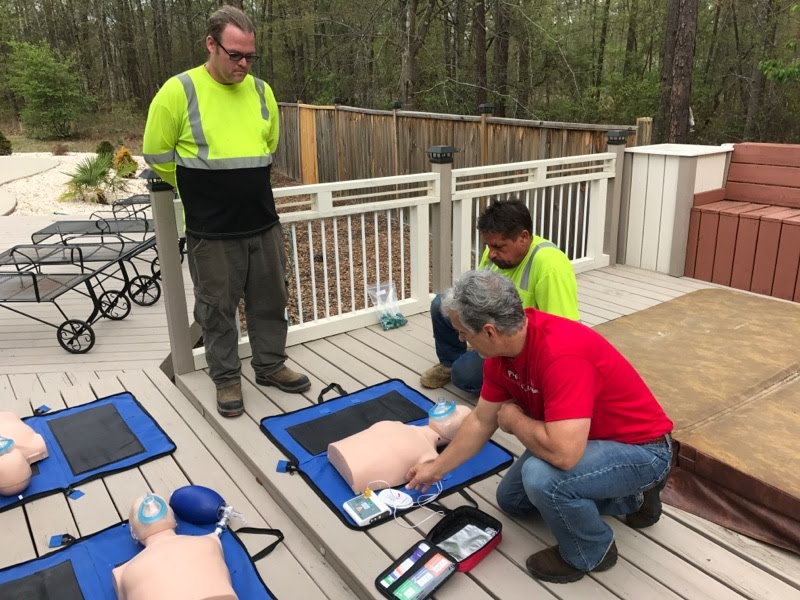
✅ Practice with professional-grade manikins
✅ Skills assessment by certified instructor
✅ Written exam
✅ Official AHA BLS Provider digital eCard
✅ Physical certification card (mailed within 5 business days)
✅ 2-year certification validity
No additional costs for retesting if needed (rare – 99.8% pass rate).
Is It Tax Deductible?
Yes! CPR certification is considered a qualified professional development expense for nurses. You can deduct:
- Course registration fee
- Mileage to/from training center
- Required course materials
Consult your tax advisor about including this on Schedule A (itemized deductions) or Schedule C (if you’re an independent contractor).
Does Insurance Cover It?
Most health insurance plans do not cover CPR certification costs. However:
- Employer reimbursement: Many hospitals reimburse BLS certification costs (ask HR)
- Nursing schools: Some programs include certification in tuition
- Continuing education funds: Use CE allowance if your employer provides one
- HSA/FSA: Generally not eligible, but check with your plan administrator
Scheduling Your BLS Class: Tips for Busy Nurses
Best Times to Get Certified
For New Nurses:
- 2-3 months before graduation (before job applications)
- During spring break or winter break (nursing school students)
- Immediately after receiving conditional job offer
For Working Nurses:
- 60-90 days before current certification expires
- During scheduled PTO or days off
- Early morning classes before evening shifts
- Weekend classes (Pulse offers Saturday & Sunday options)
Group Certification for Your Unit
Planning a group class for your hospital unit?
Pulse CPR School offers on-site training for:
- Entire nursing units (5-20 nurses)
- New graduate cohorts
- Per diem staff groups
- Multi-facility healthcare systems
Benefits of group training:
- Reduced per-person cost
- Schedule around shift changes
- Team-building experience
- Complete on-site at your facility
Contact us: 706-901-7277 or pulsecpr967@gmail.com for group pricing.

Common Questions from Augusta-Area Nurses
Can I take BLS online if I’m already a nurse?
No. Even experienced nurses must complete the hands-on skills portion in person. The AHA requires demonstrated competency in:
- Proper compression technique
- Correct hand placement
- Adequate compression depth
- Appropriate rate
- Team dynamics
These skills cannot be verified through online-only courses.
What if my certification expires while I’m on maternity leave?
You’ll need to renew it before returning to work. Most hospitals require current certification on your first day back. Schedule a renewal class during your leave or in the weeks before your return date.
Pulse CPR tip: We offer evening and weekend classes specifically for nurses returning from leave. Call 706-901-7277 to schedule.
Do NICU nurses need different CPR certification?
NICU nurses need:
- BLS for Healthcare Providers (required)
- Neonatal Resuscitation Program (NRP) (usually required)
- PALS (Pediatric Advanced Life Support) – some facilities require
BLS is the foundational certification. Your employer will inform you of additional requirements specific to neonatal intensive care.
What’s the difference between BLS, ACLS, and PALS?
BLS (Basic Life Support):
- Foundation for all healthcare providers
- Single & two-rescuer CPR
- Required for all nurses
- 2-year validity
ACLS (Advanced Cardiovascular Life Support):
- Built on BLS foundation
- ECG rhythm interpretation
- Pharmacological interventions
- Required for ER, ICU, CCU nurses
- 2-year validity
PALS (Pediatric Advanced Life Support):
- Pediatric-specific emergencies
- Child & infant assessment
- Pediatric medications and dosing
- Required for pediatric units, PICU, NICU
- 2-year validity
Start with BLS – it’s required for all nursing positions and prerequisite for ACLS/PALS.
Can I renew my BLS certification early?
Yes! You can renew up to 6 months before expiration. Your new certification will be dated from your class completion date and valid for 2 years from that date (not from your old expiration date).
Strategy: If your birthday month is busy or you have vacation plans around expiration time, renew a few months early for peace of mind.
What if I fail the BLS exam?
At Pulse CPR School, our 99.8% pass rate means failure is extremely rare. If you don’t pass:
- Skills retest: Immediate retry with instructor coaching (no additional fee)
- Written retest: Review missed questions and retake (no additional fee)
- Full retake: If needed, retake entire class within 30 days at 50% discount
Our instructors work with you until you succeed. We want every nurse to feel confident and competent.
Do I need to bring anything to class?
Required:
- Valid photo ID (driver’s license or state ID)
- Comfortable clothing (you’ll be kneeling/practicing on floor)
Recommended:
- Water bottle (staying hydrated helps learning)
- Notepad for taking notes
- Snacks (especially for morning classes)
Provided by Pulse CPR School:
- All course materials
- AHA student manual
- Practice manikins and AEDs
- Face shields and barriers
- Certification card upon completion
How long does it take to receive my BLS card?
Digital eCard: Sent to your email within 2-4 hours of class completion
Physical card: Mailed within 5 business days
Need immediate proof? Most Augusta hospitals and employers accept the digital eCard. We also provide a completion certificate you can present to HR immediately.
What Augusta Nurses Say About Pulse CPR School
Tracey T., RN (35 years experience): “Registration was fast and easy. Pricing is VERY fair and reasonable. I was very impressed with the equipment used. Their mannequins gave the closest experience to the real thing that I have used in a CPR class yet. My instructor, John, keeps you engaged, ensures understanding throughout the class, does not rush, and is willing to adapt to the needs & experiences of the learners. This was the best CPR certification class experience I have had. Highly recommend!”
Nicole M., Nurse: “I’ve renewed my BLS with Pulse twice now, and it is my go to! John makes the class fun and efficient. It’s a smooth process and my card is in my email same day. Highly recommend!”
Pam P., LPN: “This was a great class and John was absolutely the best instructor! Thank you for making this a great learning experience.”
Stacy M., Healthcare Provider: “It was a positive experience, the instructor was very knowledgeable and taught well; I would definitely recommend.”
Ready to Get BLS Certified in Augusta?
Don’t wait until the last minute to renew your CPR certification. With Pulse CPR and First Aid School’s same-day certification, flexible scheduling, and experienced instruction, you can get certified or renewed quickly and confidently.
Next Steps:
- Check your current certification expiration date (if applicable)
- Choose a class date that works with your schedule
- Register online at pulsecprschool.com/classes
- Show up on class day – no preparation required
- Get your AHA BLS card the same day
Book Your BLS Class Today
📍 Location: 110 Davis Rd, Suite 18, Martinez, GA 30907
📞 Phone: 706-901-7277
📧 Email: pulsecpr967@gmail.com
🕐 Hours: Monday-Sunday, 8 AM–9 PM
💳 Price: $49 to $69.00 (all-inclusive)
Additional Resources for Augusta Nurses
Georgia Board of Nursing
- Website: sos.ga.gov/PLB/acrobat/Forms/Nursing
- License verification: verify.sos.ga.gov/verification
- Phone: 404-424-4360
American Heart Association
- Course information: cpr.heart.org
- Find your digital eCard: ecard.heart.org
- CPR & ECC Guidelines: eccguidelines.heart.org
Augusta University College of Nursing
- Website: augusta.edu/nursing
- Student services: 706-901-7277
Augusta Technical College Nursing Program
- Website: augustatech.edu/nursing
- Program information: 706-901-7277
About Pulse CPR and First Aid School: We’re an American Heart Association Training Center serving the Augusta, Martinez, Evans, Grovetown, and CSRA communities. With over 20,000 students trained and 468 five-star reviews, we’re the trusted choice for healthcare providers throughout the region. Our mission is to provide high-quality, accessible life-saving training that builds confidence and competence in every student.
https://pulsecprschool.com/
Keywords: CPR certification for nurses Augusta GA, BLS for healthcare providers Martinez, RN CPR requirements Georgia, CNA BLS certification Augusta, nursing CPR renewal Augusta, AHA BLS classes Augusta, healthcare provider CPR near me, Fort Gordon nurse CPR requirements, Augusta University nursing CPR