
The Complete Guide to AHA Certifications: Heartsaver, BLS, ACLS & PALS Explained
Last updated August 2026 | Pulse CPR and First Aid School, Martinez, GA
Key facts at a glance:
- The American Heart Association offers four core certification levels: Heartsaver, BLS, ACLS, and PALS.
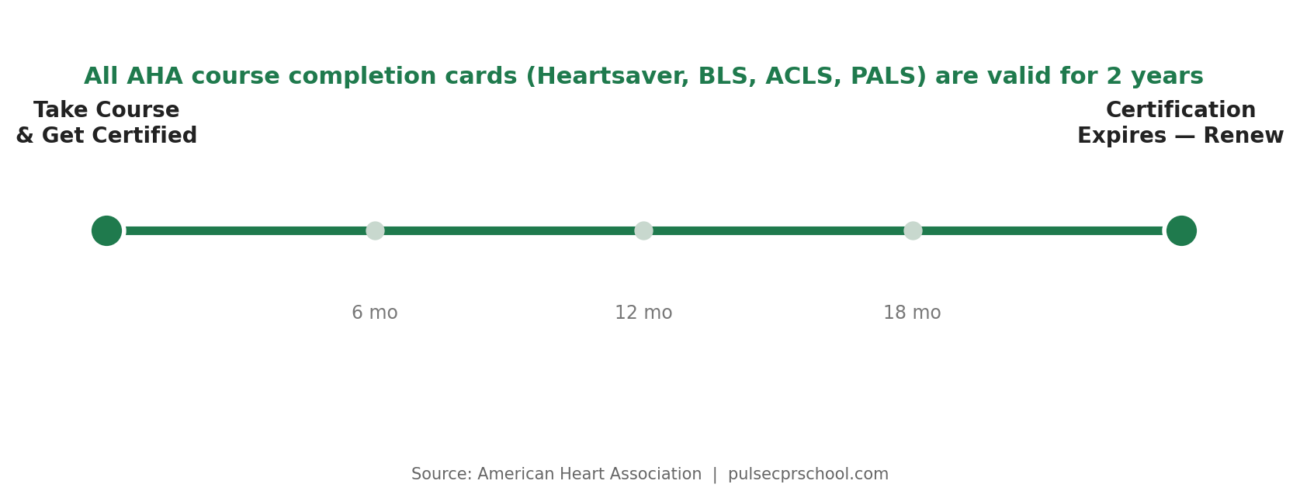
- All AHA course completion cards are valid for 2 years, regardless of level.
- BLS is a prerequisite for both ACLS and PALS.
- Heartsaver is for the general public and non-clinical roles; BLS/ACLS/PALS are for healthcare professionals.
- Every AHA course option — classroom or blended learning — results in the identical course completion card.
If you’ve ever tried to figure out whether you need Heartsaver or BLS, or what actually separates ACLS from PALS, you’ve probably ended up on five different training-center websites getting five slightly different answers. This page pulls the whole pathway together in one place, sourced from the American Heart Association’s own course documentation, so you (or whoever you’re linking to this page for) can see the entire picture at once.
The Full AHA Certification Pathway, Compared
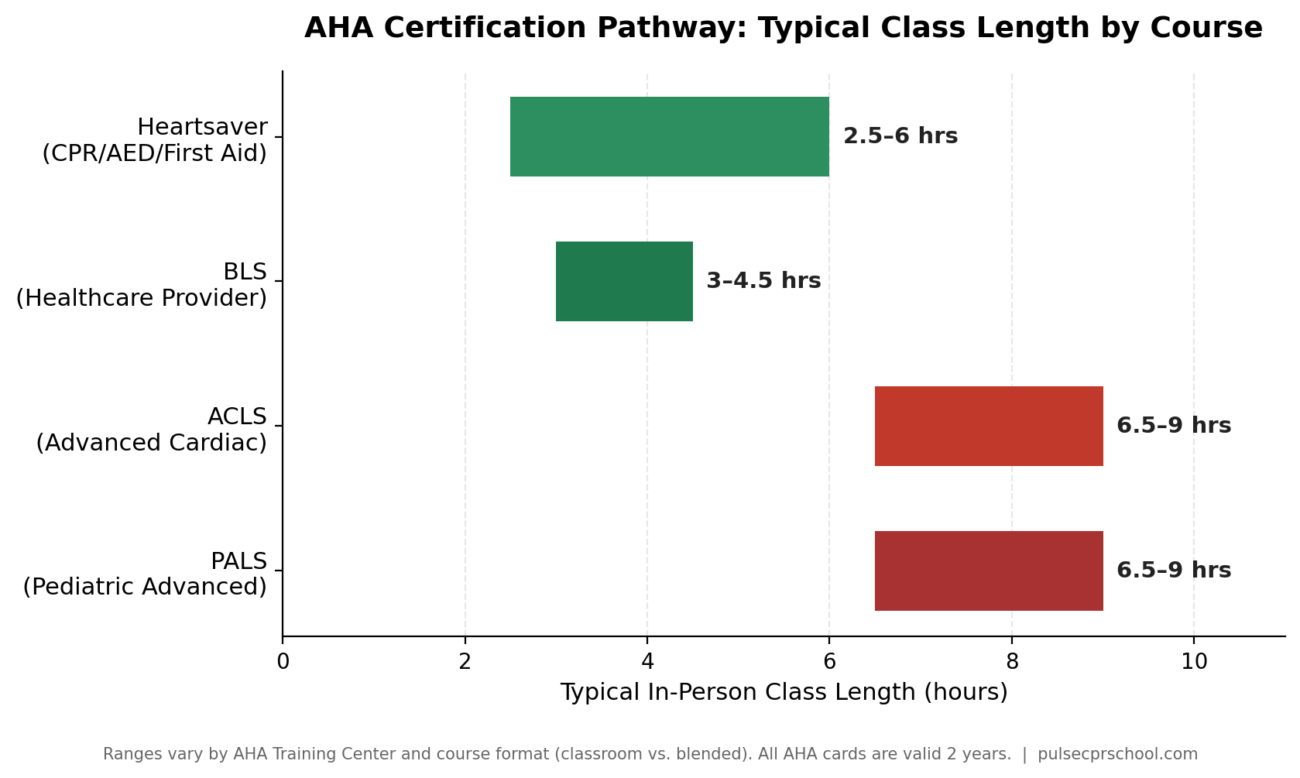
| Certification | Who It’s For | Typical Length | Prerequisite | Renewal |
|---|---|---|---|---|
| Heartsaver (CPR AED / First Aid / Pediatric First Aid CPR AED) | Anyone with little or no medical training who needs a course card for work, OSHA/regulatory compliance, or personal preparedness — daycare staff, teachers, coaches, office employees, general public. | 2.5–6 hrs (varies by specific course and format) | None | 2 years |
| BLS (Basic Life Support Provider) | Healthcare professionals and trained first responders who provide care in clinical or prehospital settings — nurses, EMTs, medical/nursing students, physicians. | 3–4.5 hrs (varies by Training Center) | None (entry-level healthcare course) | 2 years |
| ACLS (Advanced Cardiovascular Life Support) | Healthcare professionals who direct or participate in managing cardiac arrest, stroke, or cardiopulmonary emergencies — physicians, nurses, paramedics. | 6.5–9 hrs (varies by Training Center) | Current BLS Provider certification | 2 years |
| PALS (Pediatric Advanced Life Support) | Healthcare professionals who respond to emergencies in infants and children — ER, ICU, and critical care staff. | 6.5–9 hrs (varies by Training Center) | Current BLS Provider certification | 2 years |
Class lengths vary by AHA Training Center, class size, and whether you choose a classroom or blended-learning (HeartCode) format. Contact your local Training Center to confirm exact timing.
Use this chart on your own site? Copy the code below — it credits this page as the source.
<img src="REPLACE-PATHWAY-CHART-URL" alt="AHA certification pathway class length comparison chart" style="max-width:100%;">
<p>Source: <a href="https://pulsecprschool.com/aha-cpr-certification-guide-heartsaver-bls-acls-pals/">Pulse CPR and First Aid School</a></p>
Which AHA Certification Do You Actually Need?
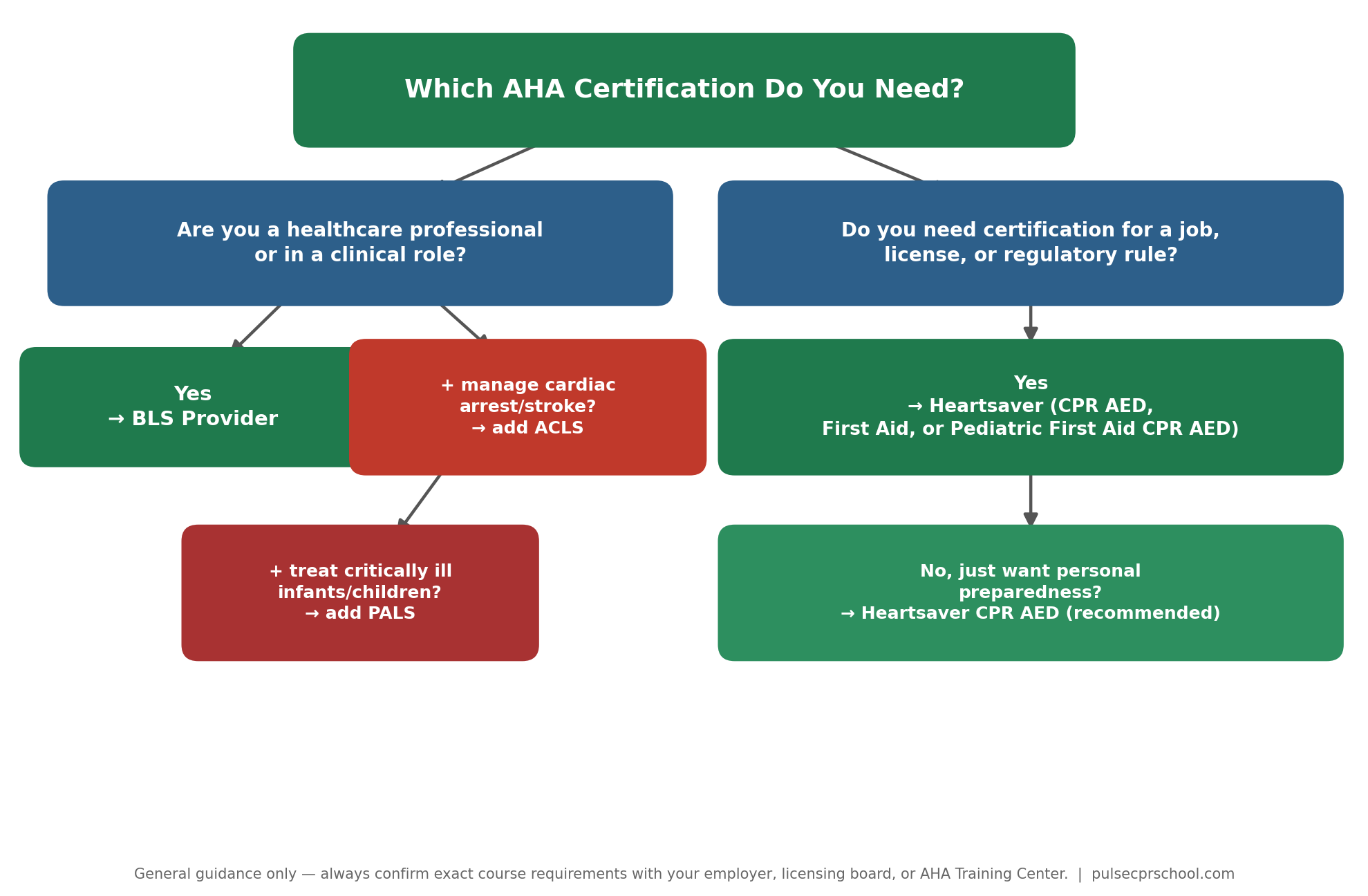
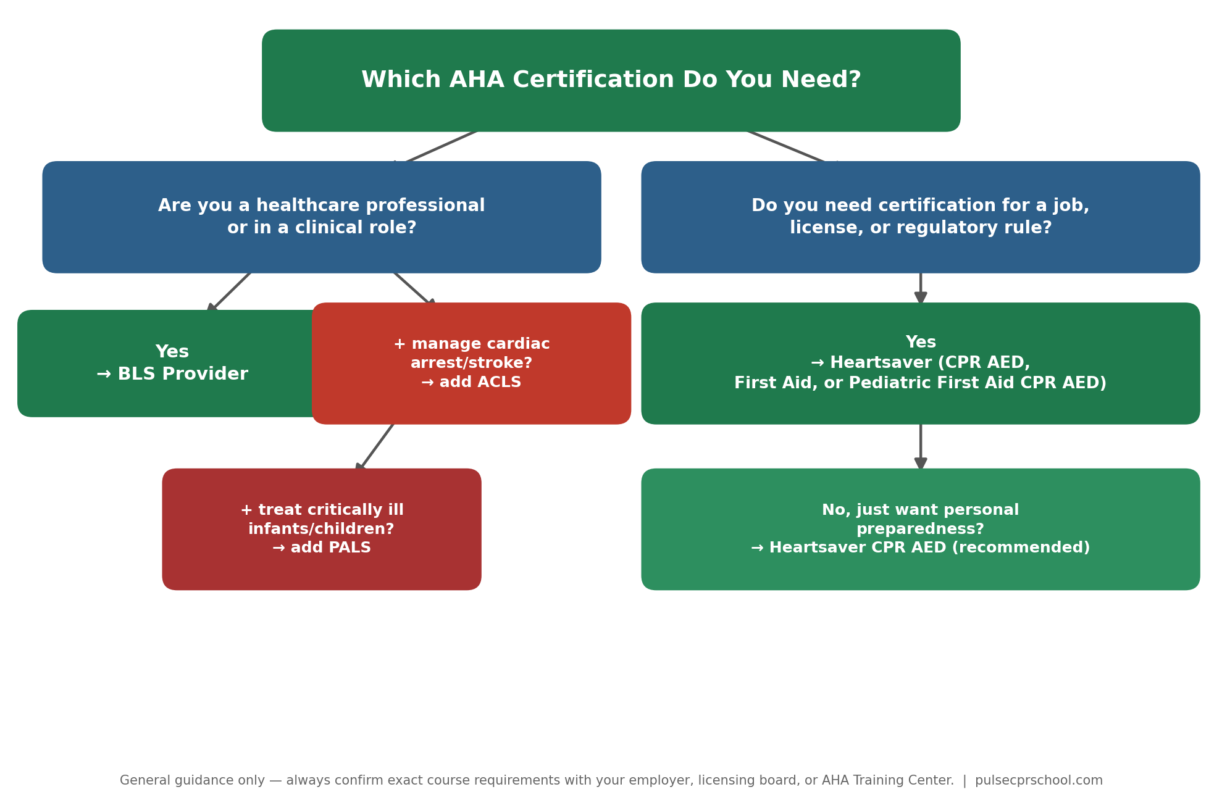
This is the question most people are really trying to answer. Use the flowchart below to find your path in a few seconds.
Use this flowchart on your own site? Copy the code below — it credits this page as the source.
<img src="REPLACE-DECISION-TREE-URL" alt="Which AHA certification do you need flowchart"style="max-width:100%;">
<p>Source: <a href="https://pulsecprschool.com/aha-cpr-certification-guide-heartsaver-bls-acls-pals/">Pulse CPR and First Aid School</a></p>
Renewal: The One Rule That Applies to All Four
Regardless of which certification you hold, the renewal cycle is the same: two years from your completion date. There’s no tiered renewal schedule where higher-level certifications expire faster — a Heartsaver card and a PALS card both run on the identical 2-year clock.
Use this timeline on your own site? Copy the code below — it credits this page as the source.
<img src="REPLACE-TIMELINE-URL" alt="AHA certification 2-year renewal timeline"style="max-width:100%;">
<p>Source: <a href="https://pulsecprschool.com/aha-cpr-certification-guide-heartsaver-bls-acls-pals/">Pulse CPR and First Aid School</a></p>
Free Download: The Full Comparison as a Printable Flyer
Want this whole comparison in one place to print, save, or hand to your HR team or staff? Grab the free one-page PDF — no email required.
Download the AHA Certification Pathway Flyer (PDF) →
Blended Learning vs. Classroom: How Each Course Can Be Taken
Every AHA certification level above is available through two formats that result in the exact same course completion card:
- Classroom course — all instruction, video content, and hands-on skills practice happen in person with an instructor, start to finish.
- Blended learning (HeartCode) — the knowledge/cognitive portion is completed online at your own pace, followed by a shorter in-person skills session focused only on hands-on testing.
Neither format is “less official” than the other — the AHA issues the same eCard either way. The right choice usually comes down to scheduling flexibility versus preferring a fully in-person experience.
Frequently Asked Questions
What is the difference between BLS and Heartsaver?
Heartsaver is designed for people with little or no medical training who need a course card for work, licensing, or personal preparedness. BLS is designed for healthcare professionals and trained first responders and covers more advanced, team-based resuscitation skills used in clinical settings.
Do I need BLS before I can take ACLS or PALS?
Yes. A current AHA BLS Provider certification is a prerequisite for both ACLS and PALS courses.
How long is an AHA certification valid?
All AHA course completion cards — Heartsaver, BLS, ACLS, and PALS — are valid for two years from the completion date, after which renewal training is required.
What is the difference between ACLS and PALS?
ACLS focuses on managing cardiac arrest, stroke, and cardiopulmonary emergencies in adults. PALS covers the same category of emergencies specifically in infants and children, including different medication dosing, airway management, and assessment approaches.
Can I take AHA courses fully online?
Most AHA courses use a blended-learning format: the knowledge portion online, followed by a required in-person hands-on skills session with an AHA Instructor. Fully online-only options without a skills check generally aren’t accepted where hands-on competency is required.
Which certification do daycare and childcare workers need?
Childcare staff typically need Heartsaver Pediatric First Aid CPR AED, which is designed to meet regulatory requirements for childcare workers across all 50 states and includes Adult, Child, and Infant CPR.
Are AHA certifications accepted nationwide?
Yes. AHA course completion cards use the same national science-based curriculum regardless of where the course is taken, so they’re recognized by employers and licensing bodies across the country. It’s still worth confirming with your specific employer or licensing board.
What’s the difference between a classroom course and a blended learning (HeartCode) course?
A classroom course covers everything in person. A blended learning course lets you complete the knowledge portion online, then attend a shorter in-person skills session. Both result in the identical AHA course completion card.
Where to Get Certified
Pulse CPR and First Aid School teaches Heartsaver CPR AED, Heartsaver First Aid, Heartsaver Pediatric First Aid CPR AED, and BLS across the CSRA, including onsite group and corporate training. See our full class schedule →
For ACLS or PALS, these are typically offered through hospital-affiliated AHA Training Centers — check with your employer or search the official AHA course catalog to find one near you.
Sources
- American Heart Association, cpr.heart.org — Heartsaver, BLS, ACLS, and PALS course pages
- American Heart Association FAQs about AHA Training
- American Heart Association eLearning course catalog (elearning.heart.org)
Pulse CPR and First Aid School provides American Heart Association-certified CPR, BLS, First Aid, and Babysitter Boot Camp training across the CSRA, including onsite and corporate group training.