
Bystander CPR in Georgia: The Survival Data, the Laws, and Who’s Actually Required to Be Certified
Last updated August 2026 | Pulse CPR and First Aid School, Martinez, GA
- Only 42.5% of U.S. cardiac arrests receive bystander CPR before EMS arrives (CARES, 2025).
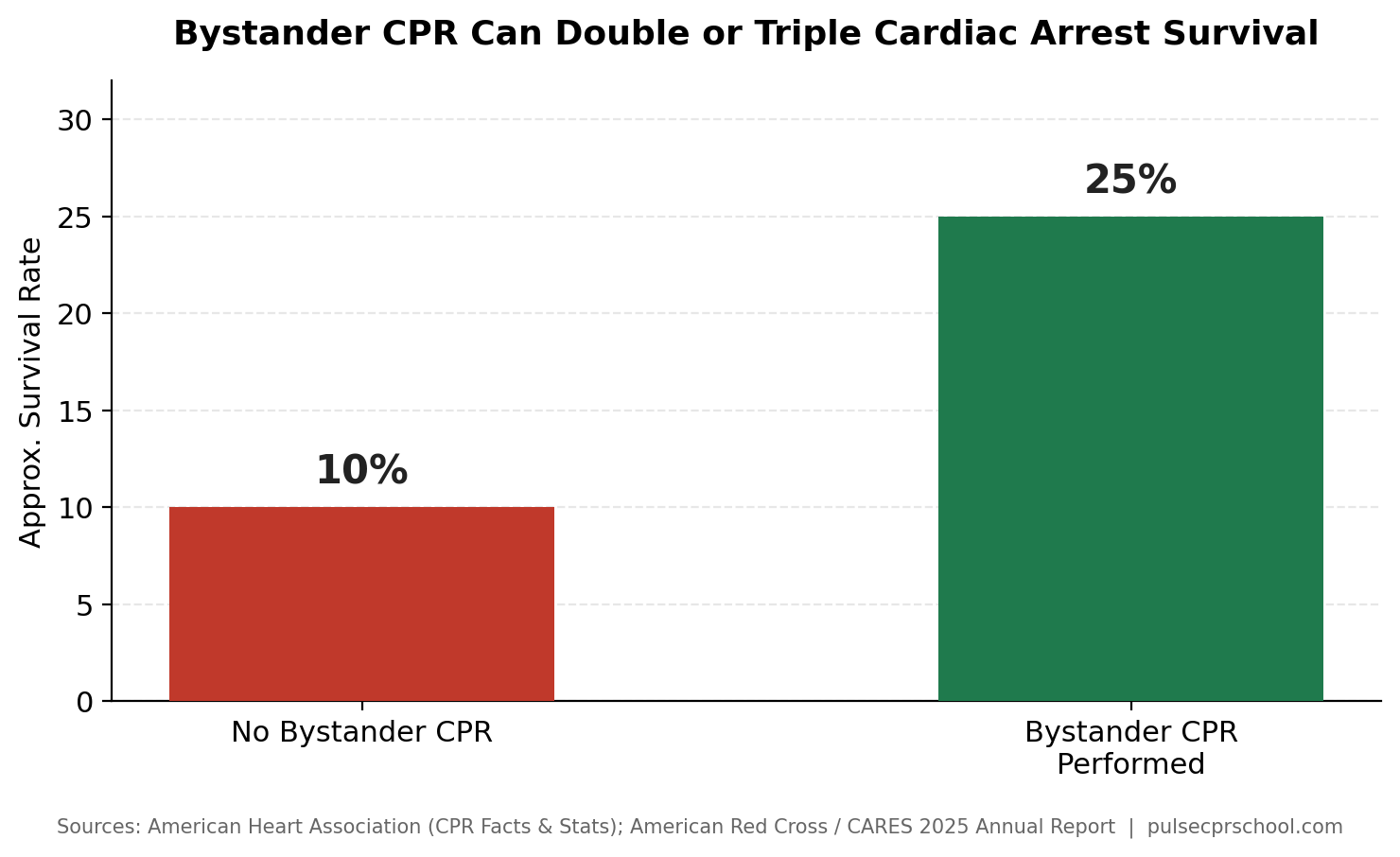
- Immediate bystander CPR can double or triple survival odds (American Heart Association).
- Georgia requires CPR instruction before high school graduation (Senate Bill 212) and legally protects good-faith responders under O.C.G.A. § 51-1-29.
- Childcare staff, healthcare providers, and public safety personnel are legally required to hold Georgia certification; many other roles are expected to by employer or accrediting-body policy.
Every year, emergency medical services in the United States respond to more than 250,000 out-of-hospital cardiac arrests. The single biggest factor separating survival from tragedy in those moments isn’t the ambulance — it’s whoever is standing nearby in the first few minutes. This page compiles the current national data on bystander CPR, compares CPR-related laws across Georgia and its neighboring states, and lays out exactly who is legally required (or strongly expected) to hold certification in Georgia. We built it as a reference — cite or link to it if you’re writing about workplace safety, childcare compliance, or emergency preparedness in the Southeast.
The National Numbers at a Glance
| Metric | Figure |
|---|---|
| Out-of-hospital cardiac arrests treated by EMS annually (U.S.) | ~250,000+ |
| Overall survival to hospital discharge | ~10.5% |
| Cardiac arrests that happen in a home/residence | Just over 70% |
| Cardiac arrests that received bystander CPR (2025) | 42.5% |
| Survival rate when CPR is performed immediately by a bystander | Can double or triple compared to no CPR |
| Workplace cardiac arrests annually (OSHA) | ~10,000 |
| People who could locate an AED at their own workplace | Only about half |
<img src="https://pulsecprschool.com/wp-content/uploads/2026/08/bystander_cpr_survival_chart-1.png" alt="Bystander CPR survival statistics chart" style="max-width:100%;">
<p>Source: <a href="https://pulsecprschool.com/cpr-statistics-georgia-who-needs-certification-2026/">Pulse CPR and First Aid School</a></p>
The pattern here is consistent across virtually every published source: the training required to change these outcomes already exists — the bottleneck is how many people nearby know how to use it. Because most cardiac arrests happen at home, the person best positioned to help is usually a family member, coworker, or neighbor, not a stranger with medical training.
Public health agencies don’t publish cardiac-arrest survival data broken out by small metro areas like the CSRA (Augusta, Martinez, Evans, Grovetown, North Augusta), so precise local figures aren’t available — that’s a genuine data gap, not something we’re going to guess at. What is documented: bystander-CPR rates vary enormously by community, with published research showing more than a five-fold difference in survival between cities with a strong bystander-training culture and cities without one. That makes local certification rates a meaningful, trackable proxy for community readiness, even without a citywide registry to measure against.
How Georgia’s CPR Laws Compare to Neighboring States
Pulse CPR trains people across the CSRA and travels for corporate work throughout the Southeast, so here’s how the core protections stack up region-wide:
| State | High school CPR graduation requirement | Good Samaritan / AED liability protection |
|---|---|---|
| Georgia | In effect since the 2013–2014 school year | O.C.G.A. § 51-1-29 — protects good-faith, uncompensated emergency responders from civil liability |
| South Carolina | In effect since the 2017–2018 school year (hands-only CPR + AED awareness, at least once in grades 9–12) | Good Samaritan protection extends to AED rescuers and device owners, conditional on training/maintenance compliance |
| North Carolina | In effect since the 2014–2015 school year | Statutory immunity for good-faith emergency responders |
| Tennessee | Training requirement signed into law in 2012 | Good Samaritan protections apply to CPR/AED responders acting in good faith |
| Florida | In effect since July 1, 2021 | Good Samaritan Act provides civil immunity for good-faith emergency care |
Georgia was actually ahead of most of its neighbors on the schools requirement, and by 2022 more than 40 states had adopted some version of mandatory CPR instruction before graduation — a genuinely fast-moving policy trend over the last decade.
Who Is Required — or Effectively Expected — to Be CPR Certified in Georgia
This is the part most articles gloss over, and where a lot of confusion (and non-compliance) comes from. Some of these are hard legal/licensing requirements; others are standard-practice expectations driven by employer policy, accreditation bodies, or insurance carriers. We’ve labeled each.
| Who | Status | Detail |
|---|---|---|
| Childcare & daycare staff | Legally required | Georgia DECAL requires Adult, Child & Infant CPR/AED and First Aid with a hands-on skills component; new staff must complete it within 45 days of hire (rule effective July 2025) |
| High school students | Legally required | Georgia Senate Bill 212 mandates CPR instruction before graduation |
| Healthcare providers (nurses, EMTs, clinical staff) | Legally required | Basic Life Support (BLS) certification at the Healthcare Provider level, typically a licensure/employment condition |
| Public safety personnel (police, fire, 911 dispatch) | Legally required | Certification maintained as a condition of the role |
| Teachers & coaches | Required by SB 212 / district policy | Many districts require staff certification alongside the student instruction mandate; often reimbursed by the school |
| AED owners (any business with a device) | Required to be trained if using the AED | Georgia law expects anyone operating an AED to be trained in its use; EMS notification of AED location is a recommended best practice |
| Camp counselors | Typically required by accrediting bodies/employer policy | Most camp accreditation standards (e.g., ACA) and employer liability policies require current CPR/First Aid, even where not a strict state statute |
| Fitness instructors & personal trainers | Typically required by certifying body/gym policy | Most national certifying organizations (NASM, ACE, etc.) require CPR/AED as a condition of certification |
| Dental office staff | Often required by state board guidance/employer policy | Frequently expected at the BLS level given sedation and airway-risk scenarios |
| Real estate agents doing solo showings, salon/spa staff, restaurant managers | Not legally mandated, but a real liability consideration | No statewide requirement, but businesses increasingly add it to onboarding given how often the public is on-premises |
Frequently Asked Questions
Is CPR certification legally required in Georgia?
There’s no single statewide requirement for every adult, but it’s mandatory for specific groups: childcare staff, high school students (before graduation), healthcare providers, and public safety personnel. Many other roles require it through employer or accreditation policy rather than state law.
Does Georgia’s Good Samaritan Law protect untrained bystanders, not just certified responders?
Yes. O.C.G.A. § 51-1-29 protects anyone who provides emergency care in good faith and without charge, regardless of formal training — though acting reasonably and within your ability still matters for the protection to apply.
Do infant/child CPR skills differ from adult CPR?
Yes — compression depth, hand placement, and rescue-breath ratios differ for infants and children, which is why Georgia childcare licensing specifically requires Adult, Child, and Infant CPR rather than a single generic course.
How often does CPR certification need to be renewed?
Most AHA and Red Cross certifications are valid for two years before renewal training is required.
Can online CPR training satisfy Georgia’s requirements?
For most roles, a blended format is accepted — online coursework for the knowledge portion, followed by an in-person hands-on skills check. Fully online-only training without a skills check is generally not accepted for licensing-driven requirements like childcare.
Why This Matters for Employers, Not Just Individuals
The OSHA figure above — about 10,000 workplace cardiac arrests a year, with only half of employees able to locate an AED — is worth sitting with if you run a business, manage a facility, or oversee HR compliance. Certification requirements aren’t only a childcare or healthcare issue; they’re a general workplace-readiness issue most companies underinvest in until something happens.
Free resource: we put together a one-page, printable Workplace Cardiac-Readiness Checklist — a quick self-audit covering people, equipment, and readiness. Download it, run it against your own workplace, and link to it if it’s useful for your readers.
Sources
- American Heart Association, CPR Facts and Stats
- American Red Cross, CPR Facts & Statistics (CARES 2025 Annual Report)
- Cardiac Arrest Registry to Enhance Survival (CARES)
- Georgia Department of Early Care and Learning (DECAL)
- O.C.G.A. § 51-1-29 (Georgia Good Samaritan Law)
- U.S. Occupational Safety & Health Administration (OSHA)
- State CPR graduation-requirement legislative records (GA, SC, NC, TN, FL)
Pulse CPR and First Aid School provides American Heart Association-certified CPR, BLS, First Aid, and Babysitter Boot Camp training across the CSRA, including onsite and corporate group training.